Here are my take-aways. At least, I think this is what they said. Any errors of interpretation are mine.
Duncan Hines was a real person. He wrote travel guides back in the days before restaurant inspections. He was more concerned about whether a restaurant would make you sick than how locally it sourced its artisanal products. // Post and Courier: Hanna Raskin
After World War II, Greeks in Birmingham changed from immigrants after our jobs to fellow Americans. They became white. (Question: how could Greeks ever not be counted as from a Western country? Greece is the birthplace of Western culture. WTF?) // Alabama News Center: Opa! and Okra: The Greek Connection By Bob Blalock
Montgomery, AL, has a large Korean population due to Hyundai. Most stay for 3 to 5 years and plan to go home when done. IT dudes often come for 3-5 months. Being intentionally temporary changes the “immigrant experience.” It becomes similar to a diplomatic mission or military deployment. // Cooking Light: Mississippi Chinese Lady goes home to Korea
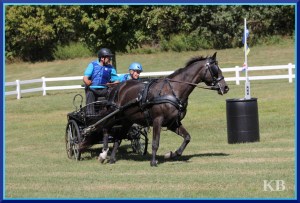
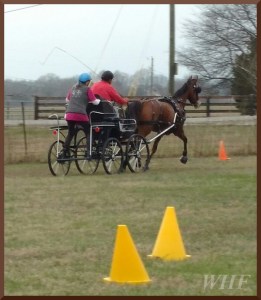
My first experience as a navigator was with Lyricc.
MTCC Driving Derby 2016 Photo by Kate Bushman
We had a blast. Lyricc is fleet-footed and nimble. She scoots.
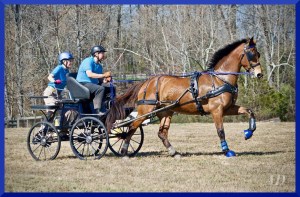
Bliss, on the other hoof, roars. The first time Bliss powered down the long side of the arena, I was suddenly acutely aware that the only thing keeping me inside the cart was my grip on the bar in front of me.
Photo by Kate Bushman
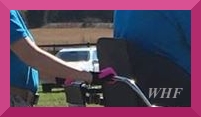
As soon as we were done with the lesson, I asked about new gloves. I had been wearing basic black leather show gloves. The kind every rider has pair or two of. Now, I wanted as much grip as I could get. Coach Kate recommended SSG All Weather Gloves.
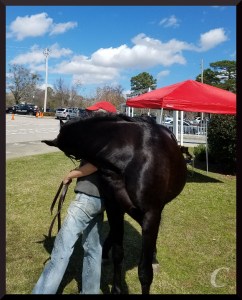
Last week, Alvin went to a local elementary school as the living demo for Pioneer Days. He was, naturally, a star.
He never swished his tail, nor stamped a hoof, nor did a thousand other normal horse things that would have endangered little toes and fingers. By mid-afternoon, he was over it. We all were. We saw 9 classes? 10? I’m not sure. I lost count. He began making dramatic air snaps at my hands and chewing on my belt, shirt, whatever he could reach. He wasn’t going to bite me, but a stinging nip was not out of the question. Yet, he remained an angel with the kids. It was as if he knew that I was a safe target for his fidgets.
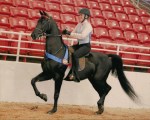
Have I mentioned what a superstar this horse is [After the Party, Awards:Hall of Fame Induction]? AND he wins in the show ring.
2013 Sandra Hall Photography
2016 Terry Young Photography
Alvin mugs me for a treat.Miss Courtney feeds Alvin a well-deserved peppermint at the end of the day.
School day photos by Courtney Huguley & Katherine Walcott.
A few days ago, I heaved my ass out of the house earlier than usual. When I walked into the locker room at the Y, I encountered a horde of grey-haired, old ladies. Seriously, it was like the rec center at a retirement community. Yes, I have grey hair. Yes, I have been qualified to join AARP for 4 years. But that’s not ME. I don’t belong with these people.
Do I?
Is this what the kids at the barn see when they look at me?
Then, the shortest, oldest, most wizened of the women turned around … and … holy crap, I want arm muscles that look like hers.
Judge not.
(Why does judgment have a negative connotation? “You are wonderful.” is as much of a judgment as “You are horrible”. Yet when we say, “Don’t be judgmental.”, we mean the latter. But I digress.)
Blog contributor [Threads Make Feathers] and photo teacher Meg McKinney [Meet Meg], is back. Welcome.
~~~
I recently gained some insight to how horses see, and comprehend – or don’t.
Background: “Slim,” my younger sister’s American Saddlebred mare is boarding at Stepping Stone Farm. When Slim arrived in Alabama three years ago from California [California Girl Becomes a Southern Belle], she was exposed to all sorts of ‘new’ – southern accents, humidity, along with peacocks, guinea hens, and donkeys.
During one of my early lessons on Slim, the guineas were patrolling the property in full force – clucking and scampering, probably 30 yards from Slim, Courtney Huguely, and myself, in the Round Pen, which is covered, and has a high, heavy post-and-rail fence, which makes a great enclosure for lessons and training.
Just seeing those little clucking birds from that distance, was enough for Slim to get skittish.
She settled down, and our lesson continued.
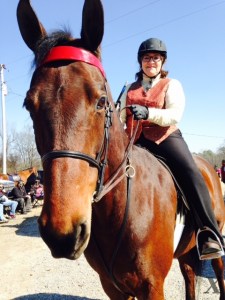
On a different day, Slim and I are ready to show. Photo by a Friend of SSF.
Then, when we reversed our direction, Courtney said that Slim would have to get used to the guineas all over again. This was because horses’ see and comprehend one side at a time, or in one direction.
What? This was news to me. Horses have two eyes, on both sides of their heads, right? Don’t they see and comprehend at the same time from both us – just like us?
No.
Slim had to get used to the guineas all over again, in the second direction.
Well, we made it through – those fierce, little clucking birds never hurt Slim from their 30 yard distance, to Slim’s great relief, I’m sure.
Recently, I was reminded of how horses’ eye sight isn’t what we think it is, or, just like ours’.
When I put Slim out in a large pasture at the front of the property, she galloped around, and had a good time. Then, she decided to make tracks to the far corner, where another horse was calmly taking in the pretty sunshine. This meant going around the edge of a pond, and through a wooded area, which Slim did at a brisk trot.
Her pasturemate was an American Saddlebred, Lynnwood’s Yorktown Imagination, aka Tiny, who is anything but. He’s a chestnut gentle giant, that measures a good 17 hands tall. His trot and canter are so long-strided, riders put bell boots on him, so he doesn’t hurt himself at the canter.
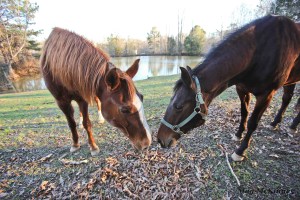
Horses meet and greet by sniffing noses. Standing this close and straight on, they probably can’t see each other’s faces, because of their wide set eyes, but they can still watch for potential predators ahead and behind them.
Tiny and Slim got along in this particular corner, on the other side of the pasture and the pond.
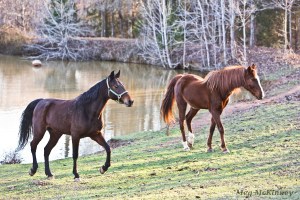
Slim, left, and Tiny, take a leisurely stroll together, seeing each other from their side vision ability.
When it came time to put Slim back in her stall, we went through the gate where they were, not the gate at the other end of the pasture, where we’d originally entered the pasture. This was a new exit – to Slim.
Then, the next day, I put Slim out with Tiny again, and used the same corner gate we had exited through the day before. She stayed in that area, and did not venture back through the wooded area, around the pond, to the larger, greener pasture, where Tiny had casually ambled to.
I remembered when Slim had to get used to the guineas, in the second direction, and wondered if she was afraid of going in the reverse direction to the open pasture area.
Sure enough, when I put a lead line on her, and began walking her back around the pond, through the wooded area, she acted like it was all new territory, and little frightening.
I kept her moving, and voila! Soon we were in the big, open area of the pasture. Slim recognized where she was, and when I let her loose, she galloped around, found Tiny, and noshed on grass.
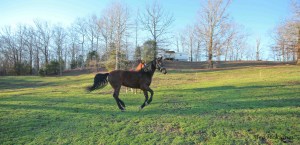
Slim gallops across the pasture, seeing in the distance ahead of her, but not the ground directly in front of her.
Soooo – what’s the deal with horses’ and their eye sight?
I asked my older sister (a board-certified veterinary pathologist) about horses’ and eyesight. She e-mailed this Wikipedia link, Equine vision, that has detailed information about how and why horses see the world very differently than humans, can judge distance for jumping, with limited color perception.
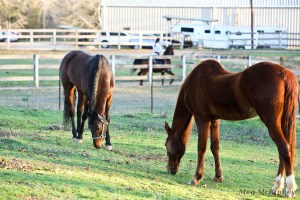
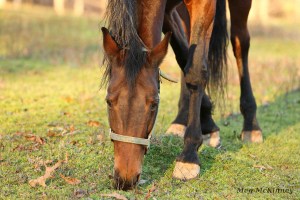
Slim, left, and Tiny, quietly graze at Stepping Stone Farm Riding Academy, with the ability to see the horse and rider in the ring, but not a few feet in front of them.
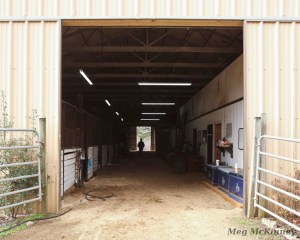
After reading it, I understood why Slim doesn’t always want to walk into the main barn hallway, from the outside — because it’s dark. I thought she was being flighty or cranky. It takes a little longer for horses’ eyes to adjust to indoor light than ours. This is the same reason why a horse will balk at loading on a trailer – it’s dark in there.
Their instincts tell them, “Danger.”
The darkened hallway of a stables may seem scary to a horse, because their eyes are slower to adjust to low lighting than a human’s eyes. What they first see is a dark place, which may have predators lurking.
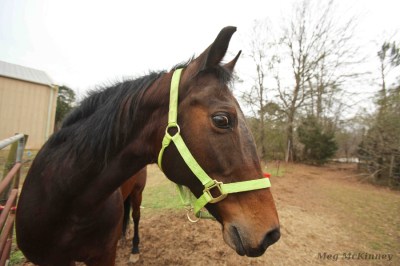
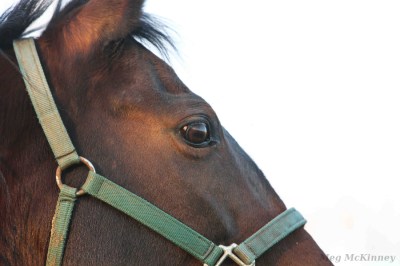
I mentioned the pasture episode to Courtney, who reminded me that horses are prey animals, and that’s why their eyes are on the sides of their heads, with their incredible peripheral vision to see beside and behind them, but not straight ahead for a few feet. Predators’ eyes, she added, are located front and center.
Horses’ eyes are on the side of their heads, providing great peripheral vision to spot predators, but Slim has to use her nose to seek grass.
In the future, I’ll be more understanding when Slim, or any horse I’m handling, balks at something that looks harmless, and familiar, to me. They see a much different world around them.
~~~ Process Notes
The intention was artistically avant-garde. Instead, I have created Poodle Letters. Sigh. I am living Ira Glass’ advice for beginners, i.e. my taste exceeds my grasp. [Definitions] Zen Pencils. Onwards!

















 Virtual Brush Box