Part 1 [Road to the World Cup: Have Saddle, Will Travel]
~~~
Like any other team sport, the U.S. Saddle Seat Team has practice. Before I went to our first practice at Cascade Stables in New Orleans, LA, many people would ask me “what exactly do you practice?” That was a question I had asked myself. What would we practice? We all know how to ride, so exactly what would we be doing?
In my opinion, practice is more for the coaches because they have to learn each rider’s strengths and weaknesses. At the World Cup competition, the team will draw 6 horses and it is up to the coaches to decide which rider will ride which horse during the competition. The coaches will have to evaluate the horse and determine what rider’s strength would fit that horse best in order to get the best scores. So at our team practice, the coaches had us ride multiple horses to evaluate what type horses we look best on and which ones we get along with the most. I rode a total of 3 five-gaited horses and did a pattern on each.
The coaches also did individual interviews. I was asked what I believe my strengths are and if I would rather rider a lazy horse or a game horse. I explained that I am an aggressive rider (could be a strength or a weakness) and a lazy horse compliments my riding style more.
When I was a kid, Jennifer Fernambucq of Heathermoor Farm, was my trainer while she and my mom had a barn together. I also rode with Desiree Clausen of Cardinal Farm for a year. This is where I got my equitation training. Other than that, I’ve had my mom as my trainer. So I had to adjust to other coaches. I am obviously not as comfortable with them as I am with my mom. When I feel something is not perfect, I can stop and pick my mom’s brain on how to make it better. With the coaches, I have to figure out how to make it perfect on my own. I guess that is because that is how it will be at the World Cup Competition.
I am extremely comfortable on a new horse. I am confident (maybe a little cocky) that I can jump on anything and ride it well. It’s hard to show the coaches this since I don’t know them well. I guess this is something that was awkward for me and maybe a little internally frustrating. I don’t know how to tell two strangers to put me on anything and I promise you can count on me.
Practice also encouraged team bonding. Although the competition is individual, we all feed off of each other’s energy and need to build trust. They want us to encourage each other and give each other feedback on the horse we are riding because your teammate might end up competing on that horse. So if I tell someone a horse I practiced on likes steady hands versus busy hands then they will trust that information to help them succeed.
We definitely bonded! We would stay up together in someone’s hotel room talking and playing games. We played the game What Do You Meme, which was a fun way to learn everyone’s personalities. We have a group Snap Chat going and we all communicate every day with one another.
All of my teammates are younger than me. I am 6 years older than the next oldest; 9 years older than the average. Although I joke about being the grandmother of the team, I don’t feel an age difference when it comes to the competition and horses. I only feel the difference when we are all hanging out at the hotel and they start talking about school or boyfriends. Then I feel like an old married lady.
We also had play time. We played horse soccer. The objective of horse soccer is the same as regular soccer, get the ball in the goal and score the most points, except the ball we used was massive. We had to use the horse to kick the ball (we basically used their bodies to move the ball around the arena) and score goals. This was probably the most fun horse game I have ever played!
Reagan, center, displays her competitive drive while playing horse soccer.
What happens when you begin to consider the eventual possibility of maybe one day showing your horse [Schedule]? He takes a month off.
Remember when I said I can’t seem to manage things that come easily to others [Laugh or Cry]? Here we are again. Greg works Milton for 6 months; everything goes great. I have one good ride; Milton goes lame.
But seriously folks.
Greys get bumps. We knew this. Milton came with bumps. We knew this. One of the bumps would wax and wane, settling into a slightly larger size with every iteration. The time would come when we would have to deal with it. We knew this.
Now is that time.
Technically, Milton has three bumps: an internal one near his boy bits, a tiny one on his tail, and one on the inside of his right gaskin. All have been deemed harmless, until such time as the mass interferes with Milton’s activities of daily living. Our vet has been loath to do anything because the bumps would just come back.
The bump in question is the one on his leg. It has gotten big enough to cause a second look to be sure he is a gelding. Ungainy. Ugly. Stinky. But not a problem. Until recently.
The bump is still the same size and grossness as before. The leg that attaches the growth has swollen. Infection? The weight of the bump straining a muscle? We don’t know. Milton is on a week of antibiotics to address/rule out the former. Then, to the vet clinic for a trim. Then, two weeks to heal.
From a horse health point of view, winter is not a bad time for this. He can heal without worrying about heat and flies and sweat. There will be plenty of cold, rainy days when he would be standing around eating hay anyway.
From human convenience point of view, now is not a bad time either. We will sit out a lot of ugly weather. Despite my excitement, we are not missing anything major. No championships. No destination events. Barring complications (cross fingers, cross fingers), our plans get pushed forward a month. No biggie.
From a whiny, self-involved point of view, I feel as if the universe said, ‘Oh, hello there. You were experiencing a moment of optimism? Let me fix that.’
With all this talk of logistics [Milton’s Schedule, Saddle Seat, Driving], do I have a plan for Rodney? Yes, the same one I’ve had for years. Keep plodding forward and hope for a miracle [Sidney Harris]. I’ve identified two mini-miracles that might almost count as steps. Not goals. I don’t do goals [Not].
1) Restart trailer acclimation sessions. Go slow. See if one day we can get him shipping locally either to the enclosed spaces of Stepping Stone Farm or to restart dressage lessons [Leg Yield]. The last time we tried standing Rodney on the trailer, he panicked so hard that he injured himself despite having his lower legs covered with wraps the thickness of mattress padding [Dubious Future].
&/or
2) Find an instructor who can come to the farm. I’d still have the footing and facility issues but at least we would be creeping forward.
What about shows? Pfffft. If eventing is not on Milton’s horizon, shows are not even on Rodney’s planet. If this doesn’t sound as positive and uplifting as last week’s plans for Milton, there is a reason for that. Stay tuned.
~~~
Above photo: inspiration for including part of the tack in an earpic came from Modern Equestrian on Instagram, View from the top. Rodney displays a suitable lack of excitement about doing his stand exercise in a new part of the pasture.
Process notes: 100 GIMP%. Too simple to drag out Inkscape. Props to my friend Sara for providing both a guest post & my theme for the weekend. [Friday] [Saturday]
No horses today. This is the Touch of Geek part of the program.
I knew Sara a long time ago in a barn far, far away. Since then she has become an author and illustrator, among her many talents. She has agreed to tell us about her new book. Author info below. Giveaway info below that. Welcome Sara.
~~~
“We need to remember that humanity can do its own saving.”
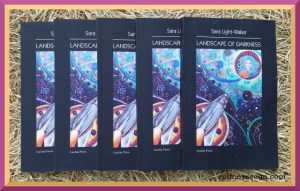
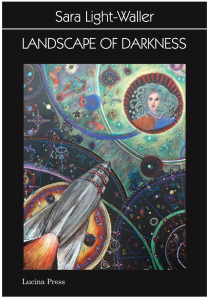
Landscape of Darkness: Creating Stability in a Time of Chaos
By Sara Light-Waller
I called my hero, Sam, because I was tired of science fiction names that sounded like the author was either stoned or had numb lips. The surname Mercury seemed natural for a space hero, although most people think of Freddie Mercury of Queen and that’s okay too.
Sam Mercury, hero of Landscape of Darkness. Artwork Copyright, Sara Light-Waller, 2018
The title, Landscape of Darkness, came to me immediately, which I took as a good sign, especially for a book that I never planned to write.
Designing a landscape
The whole thing began as a series of illustration samples I prepared for an art class. I’ve been a book illustrator since 1993 and I’m an expert style copyist — a skill I continue to develop. One of my favorite art styles is science fiction magazine art from the 1920’s to the 1950’s. Most is hackneyed and there’s a wide range of quality, especially in the interior art. But if you look past the tired content you’ll find artists well-worth notice. Earle Bergey, Alex Schomburg, Edd Cartier, Frank R. Paul, Hannes Bok, and Virgil Finlay are just a few of the notable artists from the pulp era.
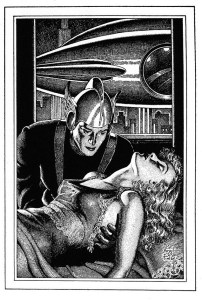
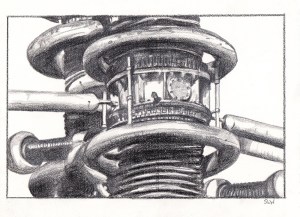
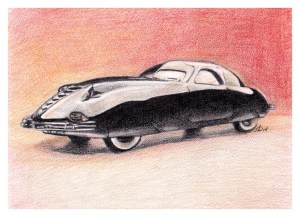
Interior art was almost done in black and white — pen & ink, pencil, or waxy pencil on a textured paper called coquille. The latter technique is little used today, but useful for creating texture patterns, similar to stippling in pen & ink, but with much less time and effort. I planned to demonstrate coquille to my class and had prepared three illustrations — a soviet-era power station, a 1920’s starlet, and an elegant 1930’s touring car — as examples.
Artwork Copyright, Sara Light-Waller, 2018
Artwork Copyright, Sara Light-Waller, 2018
Artwork Copyright, Sara Light-Waller, 2018
It struck me that the pictures made up a story. The power station looked a lot like a space station, the beautiful woman had been kidnapped and needed help, and the car…? The long lean lines are pure Art Deco and reminded me how much I love streamline design. Interestingly, this created a gestalt in my head that linked the pictures together. I went through the usual internal monologue of who, what, where, and in this case … why bother? The answer came as further inspiration — to digitally combine the power station and the girl into one image and use it for a pulp science fiction-style layout. The story began to take shape through the design, including the title and main character — Landscape of Darkness, featuring Sam Mercury of the Space Patrol.
I added the combined image to a single page magazine layout reminiscent of Thrilling Wonder Stories from the 1940’s. Initially, the text ended after the subtitle, The Lost Patrol, so the next stage was to create placeholder text. That’s when the Art Deco inspiration kicked in. I imagined a fabulous Art Deco city — Neohatten — with a retro-future spaceport and a tough local police captain. Then…I was done. There was never meant to be any more.
Original Landscape of Darkness page design. Artwork Copyright, Sara Light-Waller, 2018
I showed the page to a friend who’s not a science fiction fan. I expected a polite, “hm huh” and then a return to the previous conversation. But that’s not what happened. He read the tiny bit of story and said, “where’s the rest?”
I frowned in puzzlement. “What do you mean, where’s the rest? There is no more.”
“But there must be more.” He pointed to the page. “What does Sam Mercury do next?”
“Hell if I know,” I said.
I began writing the next day.
Looking to past for future vision
I proudly admit to being a sci-fi nerd especially when it comes to pulp-era science fiction stories. I’ve read nearly everything by Henry Kuttner, no mean feat as he wrote under multiple pen names and in several genres including science fiction, horror, and mystery. I’ve a library well-stocked with musty copies of Edmond Hamilton, Fredric Brown, Murray Leinster, C.L. More, Leigh Brackett, and E.E. “Doc” Smith. (Please don’t be mad that I left out Asimov, Bradbury, and Heinlein, I recognize their brilliance but it’s a personal taste thing.)
With all those old pulp-era stories stuffed into my head is it any wonder that I wanted to try writing one? The first thing task was to think about how to update the style for modern readers. Certain WWII-era literary conventions no longer work while others had a chance of both being useful and wonderful.
Pulp-era stories ran short, much shorter than modern novels. I felt that with blog-length attention spans and lack of free time, short form stories would be perfect for modern readers.
I’ve always liked the idea of strong heroes and in the pulp era this generally meant a human being (and despite what most people think, female pulp heroes were often bright, strong women.) Many of our sci-fi heroes today are meta-humans, cyborgs, or supernaturally-enhanced beings. For this reason I think that we have a hard time relating to them. In the older stories you felt that you could be the hero/heroine and that made you feel good.
I had no trouble designing Sam Mercury as a pulp-style hero. He’s a police captain, the kind of cop you’d want in your own town. He got a lot going on beneath the surface, but is gruff and no-nonsense on the outside.
In pulp stories humanity comes out on top. The robot never wins and the supernatural or alien force is probably out to get you. Much contemporary science fiction has reversed this trend. I think we need to reverse it again. People do not feel good about themselves. And why should they? The world is continually rocked by political chaos, war, and biohazards. Social media throws data at us so fast that we don’t know which stream to follow. We don’t need more chaos and we don’t need a savior in a red cape from another planet. We need to remember that humanity can do its own saving.
Landscape of Darkness takes place two hundred years in the future after a devastating world war. The Cyber-Threshold War destroys most of Earth’s population. In the aftermath, mankind moves away from artificial intelligence technology.
Their future is a place of renaissance where science, spirituality, and quantum physics are blended into technological development. There’s space travel and wisdom about the ultimate futility of war. My future isn’t utopian but mankind has developed a sense of responsibility for itself and its worlds.
Art Redux
Many people assume that an illustrated novel is the same as a “graphic novel.” Not so. A graphic novel relies heavily on pictures to tell the tale. An illustrated novel is a book with limited pictures, chapter and other incidental decorations. It relies on the words, not pictures, to tell the story.
(Because of formatting challenges, the electronic version of my novelette has fewer illustrations and none of the chapter decorations. I wish this could be otherwise, but it is what it is.)
I spent months working on the book cover — subject, design, how to paint it, and with what media. Authentic pulp book covers use palettes stressing two of the three primary colors, usually red and yellow, and containing several of the following elements — rocket ship, space-suited figure(s), planet, B.E.M. (Bug-Eyed Monster), and beautiful girl/woman wearing a space bikini and transparent cover-all.
Despite the continuing popularity of pulp-style cover artwork, I knew that using it for my novel would give it a “shopworn” look.
Unfortunately, modern science fiction book covers didn’t appeal to me either. Combined with my black and white interior illustrations, a slick, photo-realistic book cover would have looked like lipstick on a pig.
My only rational choice was to create something completely different. I wanted a design that was retro-future, but also forward-thinking and cool. Synchronicity brought me just the inspiration I needed in the form of a Tibetan Star map.
It occurred to me that if you’re navigating the galaxy through transdimensional tunnels your star charts might look like something like this — elaborate circular forms representing portals with charting coordinates and other vital star information encoded within the decorations.
Star map color test. Artwork Copyright, Sara Light-Waller, 2018
The medium was a bit tricky. To get the right brightness I chose fine art crayons and colored pencils on black paper. The original art piece is large and I’ve used only segments for the front and back covers. People who’ve seen the original artwork stare at it intently. It suggests a numerical language and coordinates which are not actually meaningful but seem to be. The entire piece is a story — one segment shows the Lucen system another, the transdim portal through the sun, and finally the green gas sargasso of the Delta sector.
Original artwork for the Landscape of Darkness book cover. Artwork Copyright, Sara Light-Waller, 2018
Creating Landscape of Darkness has been a privilege. I have no idea if it will be successful but I do know is that it’s a combination of things that I love — classic illustration, pulp adventure stories, and space opera — paired with my speculative ideas of how the future might look two hundred years from now. Every artist has their own vision for such things, and some people get closer to the truth than others. I may be one of those people, I may not. But what I will be is someone who had the courage to speak her truth even in a marketplace that pushes for the familiar and the comfortable.
~~~ Author Info
Sara and Percy
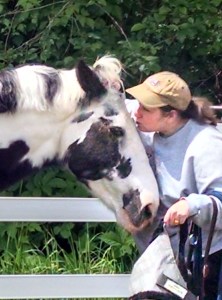
Sara Light-Waller is a freelance writer and illustrator. Also, a life-long horse person who’s bred and trained racehorses, competed in dressage and eventing, and been a practicing human and animal massage therapist for more than twenty years. Her writing website is saralightwaller.com. Her illustration and design website is flyingponystudios.com.
First five to comment here win a copy of Landscape of Darkness. I went with multiple copies, since I have proven completely incapable of choosing winners in the past [700]. US addresses only, due to postage costs.
No backroom deal. Bought books from Amazon as I believe in supporting artists. In order to have them in time for this post, I was not able to get signed copies.
Milton’s rate-limiting step for driving shows is transportation. Locally, we could drive the cart over, come back, drive the horse over, show, reverse the process. If the show is 20-30 minutes away, that equals 3 hours of shipping. Cumbersome, but not impossible. This is what we already do for the driven dressage lessons.
All we have available locally are driven dressage classes at regular dressage shows. This means modified tests to fit in the narrow, ridden dressage ring. We have to travel for anything driving specific: derbies, combined test, pleasure shows, CDEs. The closest are the MTCC shows that Greg did with Bliss last year [HDT, Derby]. Those are 4 hours away. Other places are 6 or 8 or 10 hours. Double trips are not feasible. We have to figure out a way to get horse and cart on the bus at the same time.
Thanks to the showing last year, Greg has all the gear he needs: jacket, apron, gloves, show hat, etc. Milton has the harness. We have the cart. Now we need to get there.
Oh yeah, and prepare a green horse for his first show. Details.
At least we have the local driven dressage tests to start. The first likely show to have driven dressage is a few weeks after the show Milton & I might attend [Schedule]. This gives me a strong – albeit juvenile – motivation in order to show him first.








 Virtual Brush Box