Continuing to repost the entries from my previous monthly blogs Back To Eventing and Back To Riding.
I wish I could say rereading this flash from the past led to deep insight. Alas, no. Mostly I recall the deep despair and am stunned to ponder that it has been almost four years since. OTOH, Rodney is a much happier horse.
Sherlock Holmes: [extremely irritated] Oh, hell! What does that matter?! So we go around the sun! If we went around the moon or round and round the garden like a teddy bear, it wouldn’t make any difference! Benedict Cumberbatch in “The Great Game” Sherlock [BBC 2010]. Courtesy of Wikiquote.
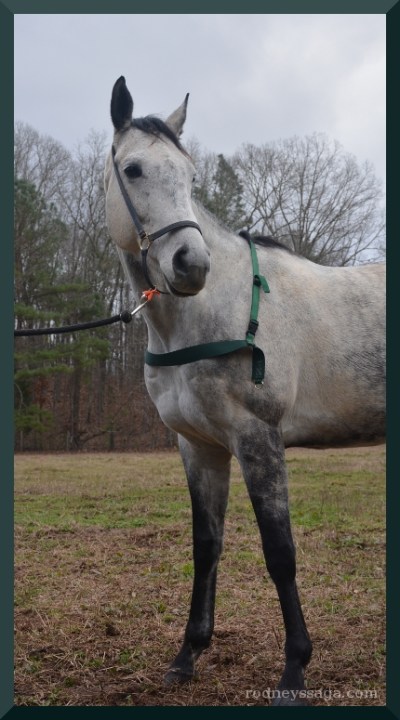
Rodney has added separation anxiety to his repertoire.
Monday: In the morning, as usual, he had a session with his heating pad to loosen a back scar from a foalhood injury. He stands. I do daily crossword puzzles. Fifty minutes is the longest either of us can go before terminal boredom.
For the afternoon groundwork session, I wanted to restart hillwork. To be as simple as possible, I chose a short, gentle slope within sight of the barn the entire way. He was nervous but in a different way than going towards the ring. Garden-variety separation anxiety. More than I cared to see, but nothing unusual.
Tuesday: Hubby goes out each morning before work to count noses and feed carrots. This morning, he used the daily treat to lead Rodney up the hill sans halter. They got 75% of the way before any stress occurred. During our heating pad session, I pondered how to play off this. Rodney is too much of a carrot mooch to use carrots regularly. Instead, I would put a hay pile at the top of the hill as goal and reward. To be even easier, I would put a second pile for the mare so that he would be walking toward company, thereby easing his separation anxiety.
That evening, we led both horses up and Rodney followed reasonably well. Hubby stayed at the top with Mathilda while Rodney and I turned around and came back down. He wasn’t relaxed but, again, did reasonably well. Then I turned to go back up the hill and
KA-BOOM
Hooves and horse everywhere. I let go of the leadrope. He tore up the hill (?!) bucking and kicking. Upon arriving, he didn’t stop (?!?!). Instead, he flew around the pasture (?!?!?!) finally fetching up in the barn/run-in shed where I caught him easily.
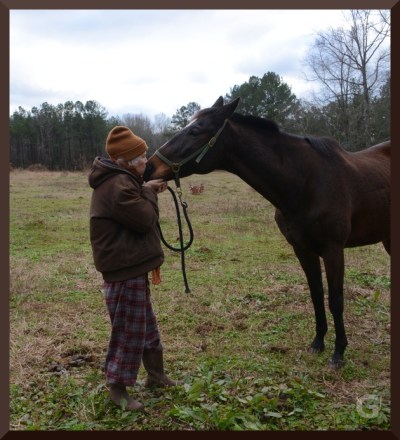
After one of these outbursts, he calms right down. If I may project, he looks as if even he doesn’t understand why he does this and is a little ashamed by his behavior. He comes over and puts his head down to my chest to be reassured and loved on. After that, he walked up the hill a few more times. Not serenely but obediently. Still, the cloud of despair had already engulfed me.
Perhaps it was time I faced facts? Perhaps, despite two wonderful rides when I tried him out, he would always be too unpredictable? Perhaps, I would never ride, much less show him? It was a dark night.
After mourning the death of my riding career (I don’t see going through this again) and lamenting the loss of the embarrassingly large number of blue ribbons we were going to win, I began to wonder, does it matter? If my darkest dread is realized, how will that change what I do tomorrow?
In 23 years, hubby and I have shared our household with 14 cats, 5 dogs, and 3 horses. The only animals we relocated were one overly-sensitive kitten who needed a quieter lifestyle and another kitten to a friend. One reason we took so long to find a horse was that we knew we would have him or her for the next 20 years.
So, Rodney is here for the duration.
Will I leave him in the field to rot? No.
Will I stop grooming and socializing him? No.
Will I stop working with him – to whatever extent he allows? No.
Many things matter in theory. In practical terms, not so much.
———-
(Removed admin notes. KTW)
Tuff Rider from Carousel Tack Shoppe. Blue for Milton, green for Rodney. No, I haven’t. However, both horses have done groundwork wearing saddle. Baby steps.
Yesterday, two readers took issue when I said that transitions didn’t matter [The Ups and Downs]. Allow me to amend the statement. The way *I* rode jumps, transitions didn’t matter.
This is partly due to Previous Horse. He was athletic & balanced to a freakish degree. (If he’d had heart, cooperation, or a competitive spirit, we would have conquered the universe. But I digress.) I kicked. He supplied the balance. He objected if I interfered. We ran around & jumped as the fences appeared in front of us.
However, this is mostly due to fundamental flaws. In my saddle seat adventure, there are three types of riding:
1) Saddle seat. I know nothing. It’s all new.
2) Hunters/jumpers/eventing/dressage. Yes, there are differences between forward seat and balanced seat. Does anyone use a true forward seat anymore? Maybe upper-level show hunters in the US? An argument could be made that both jumping & Western have become more balanced seat and that jumping has always been balanced seat in Europe. Conversely, I’m coming to the conclusion that all riding styles, for example, saddle seat and dressage, are closer than they appear on the surface. But these are matters for for another day.
In practical terms, most folks would put saddle seat in a different bin than HJED.
3) Hunters/jumpers/eventing/dressage the way I rode them. It’s not clear that #3 had anything to do with the correct execution of #2. When I do X incorrectly in saddle seat, is it because saddle seat is different, or because I have been doing X wrong all along?
Take the example of transitions, particularly downward ones. Pull for duration of transition. Horse falls into lower gait. Drop reins. Kick forward. Rearrange my knitting. Seriously, that was the plan. Getting better at transitions meant executing this routine faster & more smoothly.
Having Sam maintain the same balance while shifting gears was a revelation. Correct, jazzy walk, touch with leg, canter. Canter, touch with fingers, stay balanced, walk. Smooth, flawless transitions that were a joy to sit. Huh. Who knew. I had no idea that’s how transitions were supposed to go.
I don’t think anyone, myself included, realized how many holes remained in my riding. Oh sure, I can make it look good. I have talent and the ability to bullshit at a maestro level [NACHS III]. OTOH, this would explain why I have never been able to drag self out of the Training-level dressage/Novice eventing/low jumper ghetto.
Why am I having trouble paying attention through my transitions [Show Report: Heathermoor]? Because they have never mattered before. Dressage is all about transitions. I have never been all about dressage. Hunter flat classes are judged on the quality of the horse’s gaits, not on the getting from one to the other.
Mostly, when I showed, I jumped.
A jumping trip has no relevant transitions. Be it hunter, jumper, or cross-country, the goal is to get a canter and keep it. At the start, you are given a long run-in to set up for the first fence. At the end, you are done. It does you no harm to collapse into a heap.
Sure, I’ve done thousands of transitions over the years, perhaps hundreds of thousands. Has each one been the best possible transition I could make at the time? No. Maybe you ride as precisely at home as you do in shows. Not I.
Last week, I had a lesson on transitions. Upward is all about the preceding gait. Downward is about reminding the horse to stay balanced. Bump, sit, release (or take-and-give in dressage terms). The horse downshifts on the release. It works. This is the virtue of a well-schooled lesson horse. When I did it right, Sam rewarded me by doing it right.
1. Are you taking yourself and your blog seriously? Not the hype, the story you have to tell. I vary on this: some days, bulletproof; some days, sniveling wreckage.
2. Are you consistent? I hit this one out of the park. Posts go live every day at 12:01 am. Closing in on 1,300 posts.
3. Have you over-committed? In the past. Took a while to arrive at the current, workable level. [Where Do We Go From Here]
4. Are you writing to your ideal reader? Writing to everyone is writing to no one. I dealt with this a while back, about 10 months after the above. It’s an ongoing process, “I was still trying to anticipate an audience. That way lies madness. One cannot write for the Internet as a whole … You write the story you have to tell, then you look for an audience.” [Attitude Check ]
5. Have you found your tribe? We ought to organize equine blogger meet-ups at the big shows.
6. Do you have a mastermind group? Back in my professional writing days, I had one. It was awesome (All hail the Listgoddess). We have since wandered off to other tasks and to other social media outlets. For the Off Topic blog, I have a beta reader (Thank you). For Rodney’s Saga, I have a handful of people I whine at (Also thank you). Emails to these folks often get reworked as blog posts. If I feel strongly enough to whinge, there’s usually enough there for a post.
7. If you work with commercial brands, do you value what you bring to the table? Staying out of the sponsorship fray, for the nonce.
8. Do you have an up-to-date, one-page press kit? See above.
9. Is your elevator pitch ready? I need this. Even if I don’t want to sell ad space or my services. What is your blog about? … um … Who is Rodney? … er …
10. Ever heard of an epistolary blog? cross counter exchange is “a mother-daughter team obsessed with exploring, creating and enjoying food.” Feverishly figuring how to steal incorporate this idea.
Upside: the scarf made me noticeable. Downside: everyone thought I have a knitting blog.
Update. Origin of scarf as blog icon: Doctor Whooves. The scarf is from the TV show Doctor Who. One of those items that if you recognize it, you love it; if you don’t, you wonder WTF.
No immediate plans for an intensive Instagram campaign. A person I want to stay in touch with (waves hi) is on, so I joined. We shall see where Instagram and the spirit take me.