Thank you for reading,
Katherine Walcott
Horses & Other Interests
Thank you for reading,
Katherine Walcott
As promised, the hard copy of Greg’s article. [Life with a Blogger]
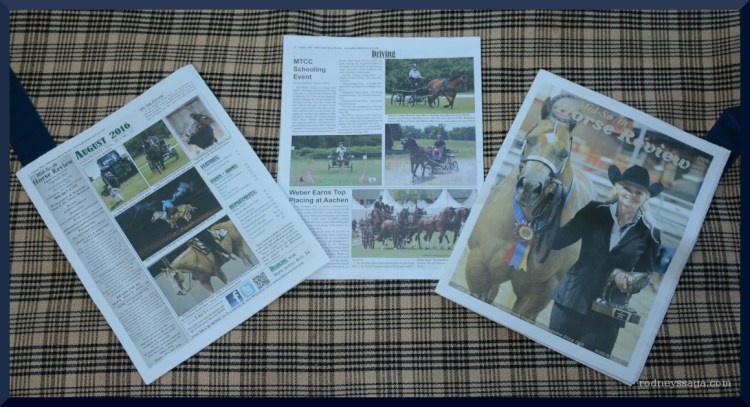
From the MTCC & MTPC Schooling Driving Event. [25 Years in the Making & Show Report]
PDF of article > Mid-South Horse Review > past issues > August 2016 > first inside page & page 22. Greg is driving the single horse, pink tie on table of contents, water jump in article.
With mandatory photo bomb.
Thank you for reading,
Katherine Walcott
Had my first 2016 boot camp double session. How did I do this four days a week last year?! [Let the Tune-Up Begin]
Last Wednesday, I had a saddle seat lesson in the morning, came home to do chores, went back for Greg’s driving lesson, and then rode a second time. The next day, I crept around the house as a pale imitation of a useful person.
On Friday, I had Stepping Stone Farm’s version of a lunge lesson [Leg Lessons]. Before I got on, I took the stirrups off the saddle. I don’t get to use them at the trot and I was pretty sure I could canter without them. Pretty sure.
Then on Saturday, we restarted the Tennessee driving lessons after our August break [Hunting Zebras, scroll down]. All I do is sit in a car, watch his lesson, then sit in a car. Why is that tiring? But it is.
Finally on Sunday, my stomach informed me, ‘Okay that’s enough aspirin for a while.’ It does this occasionally. I back off for a few days and we negotiate a truce. Nothing serious, just accumulated aches that keep me awake &/or make me cranky.
The pace will continue through September and October: driving lessons, driving shows, riding lessons, riding shows, capped off by Nationals at the end of October.

It’s all wonderful – perhaps not the aspirin embargo -, but an exhausting type of wonderful. I have already told two friends that I would love to see them … in November.
Previous 2016 post
Let the Madness Begin, Again
Thank you for reading,
Katherine Walcott
When we go up to Tennessee for a combined driving lesson, we leave at o-dark-hundred, in order to get done before the heat.
Last Saturday, I was walking up to the barn in the dark, carrying the serving buckets. It was solidly nighttime. Nothing pre-dawn about it. The air was a comfy level of warm. The minimal rural traffic was quiet. All was stillness.
That’s it. No profound thoughts. Simply a moment to recall when the frustration overwhelms me.
Thank you for reading,
Katherine Walcott


My photo teacher [Meet Meg] is also a brilliant seamstress. She sews all manner of things, including tuffets, known as footstools to us peasants. She makes, sells, and teaches about them through her business, Tuffets To You. But I digress. Since she sews, I asked about the possibility of a quilt for the letter Q this year. She made a lovely piece. However, I found the process fascinating. I didn’t want it buried in an alphabet post. Instead, I asked her to write up what was new adventure for her.
As a professional photographer, I’ve had many, many photographs published in print … But, turning a photograph into an embroidered image on fabric was a first.
Welcome Meg.
Threads Make Feathers
Photographs and Story by Meg McKinney
Oh, those glorious tail feathers that emerge every spring, just so the peacock can attract his favorite peahen. They’re so flashy and colorful, she can’t miss them, or him. He shakes them gently, reminiscent of a disco glitter ball, with high hopes for successful wooing.
During this annual wooing season, like many others armed with a camera, I try to capture this stunning sight of peacocks with their plumage. But, I’ve learned that they have their own schedule, priorities, and really aren’t interested in having their picture made. Before you can press Auto Focus, they’ve scampered away.
I got lucky a few times with my iPhone camera, one spring day at Stepping Stone Farm Riding Academy, Chelsea, AL, where peacocks, guineas, barn cats, and registered American Saddlebreds, comfortably reside.
Once the wooing season is over, his stunning tail feathers fall to the ground, like shedding a winter coat, allowing him to be more nimble for the rest of the year.
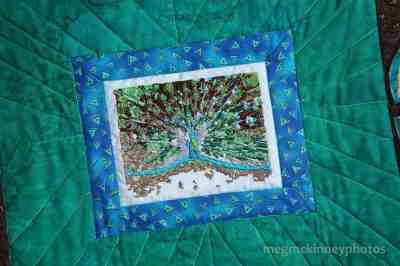
I was inspired to make a peacock-themed quilt, based on this photograph.

My quilt guild, the Evening Star Quilt Guild, Pelham, AL, had a challenge, for a sub-group, the Machine Quilting Bee, announced in May, due in August. The challenge was an outline of a stitch pattern of a bird with plumage, feathers as a quilting design, surrounded with branches and berries. It was a very pretty design. We had to turn in a finished quilt – any size – finished with quilting and binding, that incorporated this design.
I signed up for this challenge because, for me, it was a challenge – truly.
Other quilters seemed to know exactly what to do with the challenge pattern. I wasn’t sure what to do. I first thought of appliqué – French for apply – where each part of a pattern is cut out in a fabric to match the design and colors, and stitched by hand or machine, around the outer edges to a background fabric. I usually do machine appliqué on my Bernina sewing machine, using a buttonhole stitch, or small zigzag.
Naah, I wouldn’t get it finished, even with three months to make it.
Next thought – use one of my photographs of the peacocks at Stepping Stone Farm and use the machine appliqué style for peacock feathers that I’d seen in a quilt book, Black & White, Bright & Bold, by Kim Schaefer (C&T Publishing), page 15, for a quilt called “Peacock Feathers.” I would quilt the challenge pattern in the borders and around the quilt.
Ohhhh, I could just feel creative juices flowing with ideas and colors and fabrics – teals, aqua, jades, and golds for the feathers, and browns for the backgrounds, similar to stall doors.
But, how would I turn the peacock photograph into threads on fabric, that would be a peacock?
Rickie Deaver, also a member of Evening Star, and the Machine Bee, graciously came to my rescue, with her updated Bernina Embroidery Software 7 program, that can “digitize” a photograph into a machine embroidered image.
As a professional photographer, I’ve had many, many photographs published in print – newspapers, magazines, posters, brochures, album covers, and online websites. But, turning a photograph into an embroidered image on fabric was a first.
After running the peacock photograph through Photoshop, to check colors, and sharpen the edges — after all, this was an iPhone photo, and not a full sensor image from my Canon 5D Mark III camera — I e-mailed it to Rickie, who downloaded it into her embroidery software.
We scheduled a work session at her home, to digitize and stitch the peacock photograph onto a white, muslin background.
Because this photograph was more complex than usual, the computer “had to think about” some of the steps, as Rickie said. Then the Bernina program translated it into thread colors and patterns. Her patience was amazing.
Bernina’s software told us to use 10 different thread colors, and also how long it would take to stitch each one. The software estimated 1 hour to stitch the entire peacock photo.
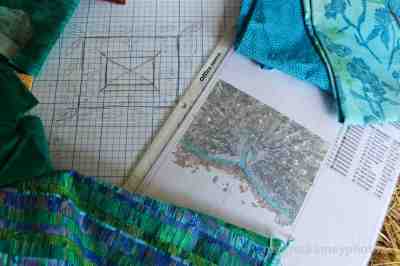
Of course, it took longer, as new projects do, but I went home with a completely stitched peacock photo on a white muslin. I kept staring at it, in amazement.
I sketched a basic drawing on quilter’s graph paper, and cut out the appliqué feathers for the border.

Next – to sew the rest of the quilt, select fabrics from my stash, assemble the top, and machine quilt the three layers of the top, batting, backing fabric, together, and sew on the binding.
That’s all.
I’m glad I had two more months to work on this quilt.
My peacock quilt wasn’t like any of the other challenge entries, and it won’t win any prizes (I can see mistakes, that any quilt judge would spot immediately). But I’ve had creative fun with my peacock photograph, and have a quilt to show for it – all because of taking on a challenge!

~~~
Meg’s links
Website, Facebook, Instagram
Meg on RS
California Girl becomes a Southern Belle, guest post with photos
Show Photos by McKinney, Vulcan & Fireworks, photos



~~~
Inspired by a passage from The Lost Symbol by Dan Brown,
Runic alphabets are composed solely of straight lines. Their letters are called runes and were often used for carving in stone because curves were too difficult to chisel. Audio CD/p123, Google Books
Or not.
Brown is admirable for his ability to spin a tale; less so for his research acumen. (Google “Dan Brown accuracy” if you want to watch history buffs frothing at the mouth.) Images of capitalis monumentalis show that ancient Romans were perfectly capable of carving curves. The Wiki entry for capitalis monumentalis, or Roman square capitals, shows the inscription on the Arch of Titus, c. 81 AD, with lovely, round Ds, Os, and Ps. In Brown’s defense, I have heard the same argument from a professor to explain why V was used instead of U, which the Arch of Titus does in “SENATVS” right above a plump, juicy O. But I have wandered from the point.
Furthermore, I took liberties with the concept. Runic alphabets are not a type but a specific set of related alphabets,
The Runic alphabet is thought to have been modelled on the Latin and/or Etruscan alphabet … The earliest known Runic inscriptions date from the 1st century AD, but the vast majority of Runic inscriptions date from the 11th century … Types of runic inscriptions include: ‘Hrolf was here’ type inscriptions on cliff walls, large rocks and buildings. Omniglot
Or, I could be in error in either case. As Brown says later in the same passage,
“Google” is not a synonym for “research.” –/p124, ibid
That last bit about “Hrolf was here” cracks me up. Historical discussion often overlooks the fact that people do things for a goof, just as much then as now.
Thank you for reading,
Katherine Walcott
Enid stood at the fence rail considering her new horse. The mare looked pretty good for having just shipped down from New Hampshire to Georgia. Robert, her favorite uncle, had sent the little pinto for Enid to compete in Combined Driving. She was thinking about a way to say thank you.
Her uncle had always wanted to compete a mini. One of the foremost mini breeders lived one county over. She didn’t have time go in person. However, the farm had solid reputation and a website. She could order online.
Inside, she fired up her computer. She picked out an adorable, little, grey gelding with a bushy black mane and Bambi eyes. She entered her card number. Immediately, the Internet police broke down her front door and arrested her.
She should have known. You never book a gift horse in the South.
After a night in jail and bail, Enid returned home. Traumatized, she decided to forget her troubles by testing out her new horse. She found harness that would fit. She sorted out the straps and buckles. With the help of a neighbor, Enid attached the horse to the cart. Immediately, the tack police zoomed up her driveway and arrested her.
She should have known. You never hook a gift horse in the South.
Ba-dum-bum-CHING.
~~~
Why?
Terrible Minds, a blog by Chuck Wendig, had a writing challenge: Flash Fiction Challenge: Behold the Idiomatic. The idea was to write a story based on suggestions from Idiomatic, a page that generates idiom mash-ups, i.e. Hindsight makes perfect. I couldn’t come up with a 1,000 word story, but it got me thinking about idioms.
Years ago, I read an article in a Sunday Magazine – I want to say the Washington Post – that had an entire page of riffs on the song line, ‘Pardon my boy, is that the Chattanooga Choo Choo?’ The one I recall is, ‘Pardon me Roy, is that the cat who chewed on your shoe?’ The Internet has this one, but neither my Google-fu nor my memory have been able to dig up the rest. You get the idea. Clearly, this had a permanent and damaging impact on my psyche.
Idioms + parody + blank space for Saturday’s post = what you see here. Hey, be glad I stopped before “cook”.
Thank you for reading,
Katherine Walcott
 Virtual Brush Box