Work: day off.
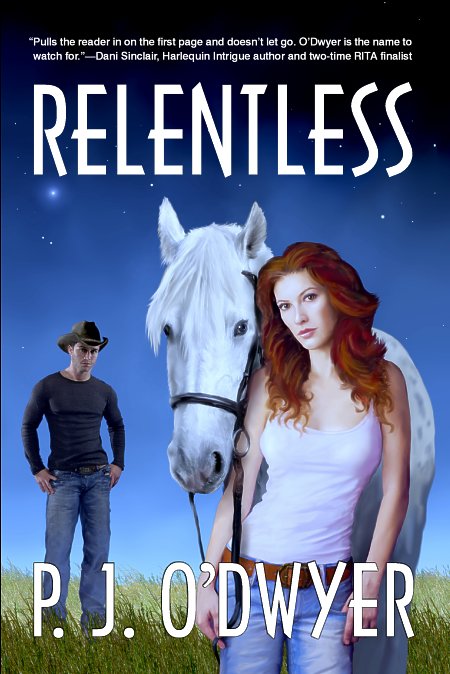
Continuing in the tradition of guest posters who offer to share the load*, P.J. O’Dwyer has agreed to discuss her new book Relentless. Welcome P.J.:
 Thank you for inviting me to spend the day with you here on Rodney’s Saga. I am an author of romantic suspense. I’ve always loved to immerse myself in a good story. Back when I was a teenager, I gravitated toward historical romances. I loved history.
But now, twenty-five years later, married to a state trooper and privy to the day-to-day police work he is involved in, it was inevitable I would combine both our passions: romance and murder. (Not that murder is his passion, only solving them.) I’m often asked if my characters are based on real people and events. They are not. But that’s not to say they are not based on real-life situations. In the case of my novel Relentless, the first book in the Fallon Sisters Trilogy, my heroine Bren Ryan operates a horse rescue farm. I got the idea from a horse rescue across the road from me. I guess driving by it every day must have formed an impression in my subconscious. Now there are other triggers for a storyline. For me, it can be as simple as one word or bits and pieces of a conversation.
Okay, you’ve got me. I confess I’m guilty of eavesdropping. But I won’t apologize. Ask any writer . . . that’s where we get some of our best plots. Writers also have an active imagination. It’s a prerequisite.
Here’s a sneak peek at my debut novel Relentless:
Headstrong horse rescue director Bren Ryan has been a red-headed streak of trouble for more than one man in Clear Spring. She’s grown up needling local “kill buyer” Wes Connelly, and since the sheriff ruled her husband’s sudden death an accident, Bren’s been investigating things herself. She’s certain Tom was murdered, and she’s hell-bent on cornering his killer the only way she knows how—by tempting him to do it again. And she’s the bait.
Rafe Langston came to Maryland looking for land and a fresh start. Or so he says. The sexy cowboy isn’t generous with details, but Bren couldn’t care less—until he buys half her farm at auction and moves into her childhood home. Suddenly, the last man she should befriend becomes her only ally in solving her husband’s murder. Soon their cozy stakeouts sizzle with unexpected desire neither one can ignore, threatening his mysterious plans and her promise to never fall in love again—especially with a handsome stranger whose secrets could shatter what family she has left.
 It was during my research for Relentless I realized I had found something I could be passionate about. Yes, I’m passionate about writing, for sure. But learning about the suffering our horses endure every day in the name of greed gave me a reason to finish this book. As a writer, I believe we are entrusted to entertain as well as educate. Relentless gave me the opportunity to do both and became a reality because of the gracious nature of horse rescuers who took a call from a stranger, listened and agreed with enthusiasm to read Bren’s story, and offer their insight and knowledge. They hold a special place in my heart, and as a way to thank them for their kindness and because their fight has become mine, I am donating 5% to horse rescue for every book sold in the trilogy and any other future works. The only catch—you must purchase the books on my website at http://www.pjodwyer.com. There is a list of rescues to choose from including most states, a fair amount of provinces in Canada, and a few in the UK to include my homeland of Ireland, as well as, Australia and New Zealand.
With Relentless soon to be released on April 15, I am busy with the final edits of the second book in the series entitled Defiant, which is Kate’s story, set for release in September. Gorgeous as she is idealistic, this sister wants more than just horse pastures. Next, on my list is the third and final book of the series Forsaken. Dani is the sister neither Bren nor Kate know about, yet. That is until the beautiful Irish barmaid Dani Flynn finds her homeland just a spec on the horizon behind her and open seas dead ahead. She’s poised to change everything Bren and Kate believe to be true. And they’re not the only ones. There was no way I couldn’t write a book about Bren’s best friend Kevin Bendix. More like the brother Bren never had, eventually, they would become family—even if it was by law. I loved writing Kevin. Maybe it’s because I have one just like him at home. It was fun to ruffle this guy’s serious exterior.
Here’s a sneak peek into the life and times of Mr. Law-and-Order:
Sheriff Kevin Bendix’s life is orderly and free of complications. That’s the way he likes it. But that’s all about to change with one gorgeous, blue-eyed brunette who can’t prove she’s in the U.S. legally. It’s his job to have her deported. Only his attraction to Dani Flynn is clouding his judgment. She isn’t your average law breaker. All of about five foot two with a face of an angel and a body of a sinner, she will be his undoing. It’s not only his heart she’ll steal. Loving this woman could cost them both their lives.
I try for strong, likable characters readers can identify with and a plot with a high level of anticipation, uncertainty, anxiety, and sometimes even terror/fear. That’s why I love writing suspense. Whenever possible, I like to create one surprise, something the reader didn’t see coming, usually placed toward the end of the story. And, of course, there’s got to be great chemistry between the two protagonists and a burgeoning love story that warms the heart as menace and mayhem unfold around the pair. If you’ve ever thought about writing, I encourage you to follow your dream. I never had any formal training as a writer, only the desire to put my thoughts and stories on the computer screen. Like anything else, it takes practice and commitment. Writing is a craft, and with time our writing becomes better, sharper, and stronger. Just remember, writing is a journey that never ends.
If you’d like to learn more about P.J. O’Dwyer, here’s where you can find her on the web: website, Facebook, Twitter, Linked In. Giveaway: Autographed copy of the hardcover edition of RELENTLESS.
How do you incorporate charity into your life or work? One commenter will be awarded the giveaway copy on April 15 – to counteract the karma of the day.
(*For which I am exceedingly grateful. List of previous book posts, List of previous guest posts. [Yes, double clicking will be required. Such is the price of a comprehensive list.]) RS






 Virtual Brush Box