Show Pix

Last weekend, the barn began the show season. WITHOUT ME. They all had a grand time. WITHOUT ME. Ribbons were won. WITHOUT ME.

Photo by Courtney Huguley

I was aided in surviving this tragedy by regular updates on the SSF Facebook page. Particularly since I went to the show last year [Report] and could recognize the backdrop of the photos.

T. Ed Garrison Arena showgrounds Clemson, SC 2014 Photo by Courtney Huguley
T. Ed Garrison Arena showgrounds
Clemson, SC
2014
Photo by Courtney Huguley
T. Ed Garrison Arena showgrounds Clemson, SC 2013
T. Ed Garrison Arena showgrounds
Clemson, SC
2013

I deeply appreciate the effort that went into keeping us stay-at-homes updated. Even with a cell phone camera, it takes time. Recognize a photo op. Halt the horse show machinery. Snap photo. Type a quick caption. Upload. Resume forward progress.

I found out how much of an interruption updates can be from tweeting horse shows. I yap incessantly the night before and the morning of. As soon as competition starts, radio silence.

Interlude

Taking a break from Text Art to give you a mare update.

The look of ancient eagles

Mathilda is ticking along. Last week, the blacksmith trimmed her front feet. We didn’t even try for the hinds. It’s amazing what removing a few millimeters of hoof can do for her balance and attitude. As soon as her pedicure was done, she perked right up. Although, she’s had a pretty good attitude all along.

I recall an anecdote from an end-of-life counselor, I think it was Bernie Siegel, but don’t want to put words in his mouth if I’m wrong. Anyway, counselor is in hospital room with patient. Patient is terminal. Patient says she is “ready to go”. Phone rings. Patient answers phone. Counselor says, if you feel there is anything on the other end of the line that you need/want to hear, you are not ready to go.

Mathilda not just answering the phone. She’s making calls. She’s texting. She’s posting on Facebook. She’s hanging over the back fence checking out what the neighbors are up to.

If she’s willing to fight, so are we.

Hard at work
Hard at work

BTW. Photos taken with cell phone. She doesn’t realize these are cameras. Yet.

Gimme!
Gimme!

______________________
So as not to disappoint the typographical fans completely, your text amuse for the day:

aa649cf47d74f0f41c6377ac0c932cc3-the-best-tweets-from-neil-degrasse-tyson

20 Times Neil deGrasse Tyson Blew Everyone’s Mind On Twitter

Off Topic: 2 + 2 = 4

Caveat: Today’s subject is not about horses. For more non-equine subjects, see my other blog, Off Topic. Rodney’s Saga returns to regularly scheduled programming tomorrow.

(I wrote this dialogue a few years back as a paper for a graduate class in Modern Rhetorical Theory.

Sidebar: at the first class meeting, we were asked to define the three terms. We all basically agreed on the meaning of “theory” and took wild guesses on the meaning of “rhetorical”. When it came to “modern”, my classmates said 10, 50, 100 years. I said, “Anything since 1450.” End sidebar.

The professor had me rewrite this paper. I’m not sure which version I have here. Either way, you get the idea. Plus, I cut about a page of student puffery. Available upon request, although I have no idea how anyone but the assigning professor could stay awake to read it. But I digress.)

Wise—And—Completely—Knowledgeable—Orator: Allow me to pose a question, is 2 + 2 = 4 a rhetoric statement?

Compositionally—Required—Eternal—Target—In—Narrative: Of course not.

WACKO: Many would take your position. Even those who feel that rhetoric is nigh on cosmically inclusive draw back from saying science or mathematics is rhetorical.

CRETIN: Sure. After that you can prove that black is white.

WACKO: Another day perhaps, mathematics and rhetoric are enough for us at this moment. And so to work.

The Existence Argument — I
WACKO: Is 2 + 2 = 4 a rhetorical statement?

CRETIN: No. Rhetoric may change from one period of history to another. Math does not shift over time. It just is.

WACKO: It is and always has been?

CRETIN: Yes.

WACKO: And 2 shares this happy destiny with other numbers? For example, 1?

CRETIN: Yes.

WACKO: So I may take one step back from 2 and get 1. Will you allow another step from 1 to 0? After all, 2 + 0 = 2 is the same premise as 2 + 2 = 4.

CRETIN: Okay, 0 it is.

WACKO: Yet, until a mere 900 years ago, Europe had no concept for 0. When it was introduced from the from the barbaric Muslims to the enlightened West, Europe recoiled in shock. In 1299, Florence banned Arabic numerals, 0 among them.[Seife 80]

CRETIN: I shouldn’t have agreed about 0. After all, even in math it is unique as the one number you cannot divide with. But that’s just for O.

WACKO: Not the rest of the numbers?

CRETIN: No.

The Existence Argument — II
WACKO: Is 2 + 2 = 4 a rhetorical statement?

CRETIN: No. It just is.

WACKO: And what would you mean by that this time?

CRETIN: It is true not matter what you add. Rhetoric deals with things that may or may not be true, while mathematics deals with certainties.

WACKO: Always true, you say? It does not matter what I add?

CRETIN: Yes. 2 trees, 2 cousins named Sonja, 2 shopping days left until Christmas. Whatever you add 2 of something to another 2 of something you get 4 of something.

WACKO: Let us suppose you were taking a train journey. Along the way, you spotted a lovely little house that you wished to examine a while longer. How would you do that?

CRETIN: I could walk toward the back of the train, looking out the windows as I went by. If I could walk the same speed as the train, I could keep the house in sight until I ran out of train.

WACKO: So, your speed would cancel out the speed of the train and you would stay in one place?

CRETIN: Yes.

WACKO: Let us further imagine that this train is going 2 miles per hour and you walked 2 mph. Could you say that the 2 mph speed of the train + 2 mph speed of the walker = 0 mph?

CRETIN: Ha, you are trying to trap me. You are using speed when you really should be talking about velocity. If you include a directional component to your argument, then 2 mph velocity of the train — 2 mph velocity of the walker = 0 mph. It becomes — because the directions cancel. So 2 — 2 remains = 0.

WACKO: Very well then. We will discuss the addition of velocities. Let us consider what happens if you turn around and walk toward the front of the train, what would be the result?

CRETIN: Easy. 2 mph train + 2 mph walk = 4 mph for walker.

WACKO: Correct. What if you and the train could both go 20,000 mph?

CRETIN: The same. 20,000 mph train + 20,000 mph walk = 40,000 mph for walker.

WACKO: Again correct. How about 200,000…. Wait, this is getting tiresome. Let us chose a number X. Would 2X mph + 2X mph = 4X mph?

CRETIN: Yes, yes, I keep telling you 2 + 2 = 4. It doesn’t matter what you add.

WACKO: What if a X is 33,480,000? Think carefully before you answer.

CRETIN: It doesn’t matter, I tell you. I don’t care if a X is one or a million. The answer is 4.

WACKO: I am sorry but in this case, you are wrong. If you and the mythical train are both zipping through the ether at 33,480,000 mph, then 2X (66,960,000) mph + 2X (another 66,960,000)mph = 2X (66,960,000) mph. Remove that cloud of confusion from your brow. Perhaps you would be more familiar with our chosen velocity of 2X if I called it 186,000 miles per second, otherwise known as the speed of light. Nothing can go faster, even in the face of apparent conflicts.

CRETIN: That’s unfair. Relativity is a special case.

WACKO: But it is a way to construct a logic example where 2 of something + 2 of something NOT = 4 of something. You said it did not matter what I added, that 2 + 2 always and forever = 4. If a thing is true, should not it be true for all cases? If is not 100% true, does not that make it probably true? Did you not say that probability is the realm of rhetoric?

CRETIN: You’re trying to tangle me up with word games.

WACKO: Funny that you mention words.

The Language Argument
WACKO: Is 2 + 2 = 4 a rhetorical statement?

CRETIN: No, it is a mathematical statement.

WACKO: And please inform me of the difference.

CRETIN: As you said in the beginning, rhetoric involves language, so a rhetorical statement uses words. A mathematical statement is about numbers.

WACKO: Let us take this in pieces. What does it mean when I draw a bar across a page and then a second one on top of it, like so =.

CRETIN: It is an equal sign. It means the stuff on one side is the same as the stuff on the other. In that example you are so fond of the equal means that 2 + 2 is the same as 4.

WACKO: Why? Why doesn’t a bar with second one on top of it mean to combine the numbers, like this, 2 + 2 = 22?

CRETIN: That’s silly, what would be the point of that operation?

WACKO: I do not have any idea. The point of the question, however, is that it is a valid way of interpreting the double bars. Only the fact that you and I have agreed on a meaning enables us to use is as we do. Now, would not that be a good definition of a word? I draw particular lines in the sand, then you and I agree on what those lines mean.

CRETIN: Say what you want but 2 is still 2.

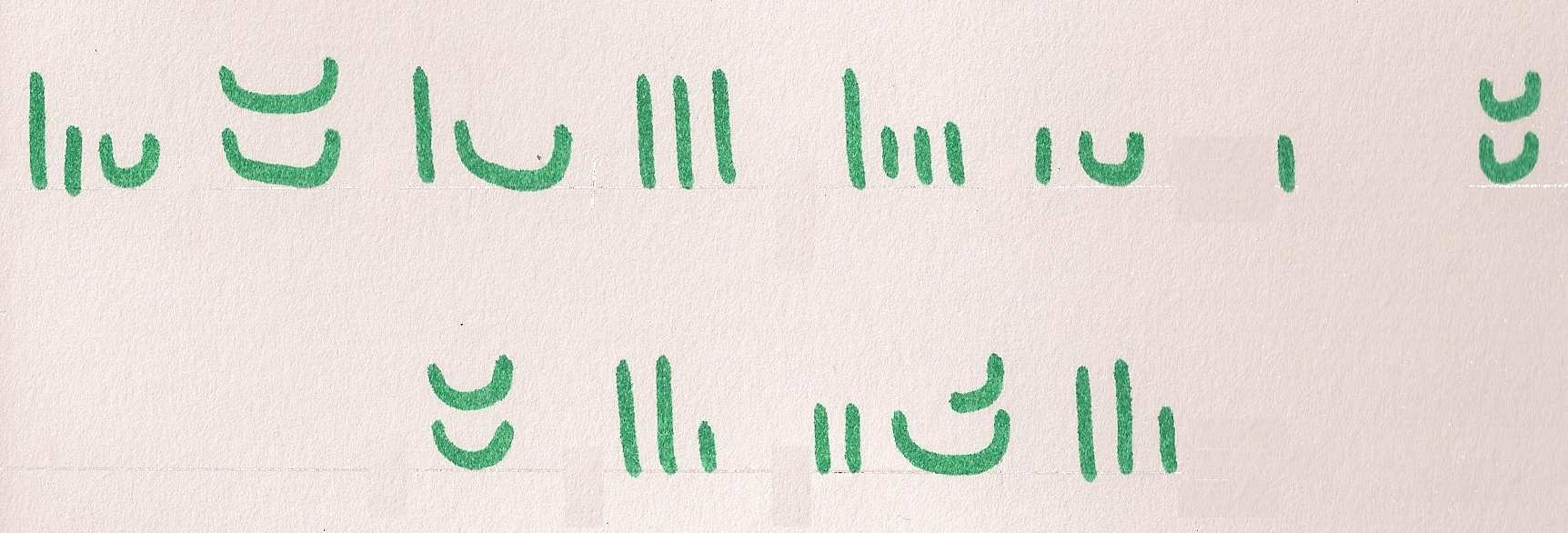
WACKO: Is it? Is not also two? Indeed in ancient Brahmi your 2 was represented by two lines suspiciously like your equal sign.[Seife 68]

CRETIN: Okay, call it 2 or two or Fred. Use whatever symbols you wish, but the numbers are still numbers and the equation 2 + 2 is a manipulation of numbers not a discussion.

WACKO: It is not? Demonstrate to me what you mean by mean by 2 + 2.

CRETIN: It means 2 (holds up two fingers on the left hand) and 2 (holds up two finger on the right hand). Put them together and you have 4. (Counts) 1,2,3,4.

WACKO: So 2 + 2 means you count to 4?

CRETIN: Yes.

WACKO: So then what is 4?

CRETIN: 4 is 4. (Holds up one hand, counts) l,2,3,4.

WACKO: Therefore, have we not just established that counting from 1 to 4 is the same as counting from 1 to 4? That 2 + 2 is a different way of saying 4? Could it be that it is a definition of 4? Do we not begin what you call discussions by defining our terms?

CRETIN: Okay, it is a definition. But mathematics uses definitions. It is still not a persuasive discussion.

WACKO: Oh no?

The Persuasion Argument
WACKO: Is 2 + 2 = 4 a rhetorical statement?

CRETIN: No, because you are not trying to persuade me of anything.

WACKO: Am I not?

CRETIN: We already agree, therefore no persuasion is necessary.

WACKO: And all rhetorical statements involve persuasion?

CRETIN: Yes. Either two people present different sides of a case, as in a court of law, and a third person, the judge, decides the matter. Or one person attempts to persuade one or more people of his or her viewpoint, as with this insane crusade you have to say that math is not math.

WACKO: So rhetoric can be one person attempting to persuade another?

CRETIN: Yes, of course.

WACKO: Must the two people always violently disagree?

CRETIN: The amount of disagreement might vary. If you are trying to persuade loyal
Democrats to vote for a Democratic—sponsored bill, it would be easy. However, if you try to persuade Republicans to do the same, it will be harder.

WACKO: So we may have a range of agreement from complete opposition to near agreement?

CRETIN: Yes.

WACKO: To use your example, what if I asked the Senator who originated a bill whether or not he would vote for it?

CRETIN: Well, of course he would vote for it, it’s his bill. Or hers.

WACKO: So how would I go about trying to persuade him — or her — to vote for the bill?

CRETIN: The Senator already agrees, therefore no persuasion is necessary.

WACKO: So there are forms of rhetorical statements were no persuasion is necessary?

CRET IN: Maybe the statements about numbers are subject to discussion, but a number is still a number and no amount of your verbal gymnastics will make it go away.

WACKO: No?

The Culture Argument — I
WACKO: Is 2 + 2 = 4 a rhetorical statement?

CRETIN: No it is a statement about concrete things. Rhetoric is about things that require discussion to be agreed upon.

WACKO: Concrete things, you say. Please show me a two. Not, two things, just a two.

CRETIN: I didn’t mean concrete in that way. I objective statements. Nobody argues about what two is.

WACKO: They do not? Would your concept of two be similar to the concept of the color blue?

CRETIN: Sure, you can’t point to blue by itself, but everybody knows that it is.

WACKO: Everybody?

CRETIN:, Yes. Blue is blue.

WACKO: So, blue is not to be mistaken for another color, say green? And in turn green is not to be mistaken for yellow?

CRETIN: Be serious.

WACKO: I am quite serious. As are the Keresan Pueblo Indians who have no separate terms for blue and green. Or the Natchez Indians who do not differentiate between green and yellow but instead have one word for both colors. [White 2354] What would you say to them?

CRETIN: I would say we have gotten off the track. You are going on about colors to prove a theory about numbers. I dare you to make the same point about numbers.

WACKO: You dare me?

The Culture Argument — II
WACKO: Is 2 + 2 = 4 a rhetorical statement?

CRETIN: No, rhetoric depends on the audience and the speaker. Mathematics is impersonal. It does not matter who makes the statement. Everyone agrees on numbers.

WACKO: Everyone?

CRETIN: Yes, everyone. As long as you don’t count zero. That is a special case.

WACKO: Your mathematics appears to be full of special cases. However, I would not dream of mentioning zero again. I wish to talk about other numbers.

CRETIN: Not irrational numbers.

WACKO: Rest easy, my dear Cretin. Not irrational numbers, not negative numbers, not even fractions which are as real as the half of a pie you insisted on eating all by yourself last night.

CRETIN: I was hungry.

WACKO: Constantly. Be that as it may, I wish to address plain everyday integers, 1, 2, 3, etc.

CRETIN: Okay.

WACKO: You say 2 exists in some way, as yet undefined, but absolute.

CRETIN: That’s a little severe, but for argument, okay.

WACKO: Does 20 exist in this same mysterious way as 2?

CRETIN: Yes.

WACKO: How about 30?

CRETIN: Yes.

WACKO: How about 40?

CRETIN: Yes.

WACKO: And 50?

CRETIN: Are we going to count to one hundred by tens?

WACKO: No, fifty is far enough. So you say two is an object — of some sort — and not an item for discussion. And that the same is true of 50.

CRETIN: Yes, if a group of people have 50 yak eggs, they have 50 yak eggs. I don’t care where they live.

WACKO: How about in Africa?

CRETIN: I don’t think they have yaks in Africa.

WACKO: Nor much familiarity with your universally accepted concept of fifty. Among the Kpelle people of Liberia, perfectly intelligent adults have difficulty solving problems that use numbers greater than forty. They do not even have a word for ’number’ in their language. The closest they come is an artificial word for ’many—ness’ imposed by outside linguists.[Gay 42] They might agree with you that 2 + 2 = 4 but they would have trouble with 200 + 200 = 400. Do big numbers have less of your ’objective existence’ than little ones?

CRETIN: No, but what you have said doesn’t make sense.

WACKO: I’m glad you mentioned sense.

Conclusion
WACKO: Is 2 + 2 = 4 a rhetorical statement?

CRETIN: Well, maybe. If I say no, you will come up with another reason to confound me. Yet,that goes against my common sense.

WACKO: How so?

CRETIN: A rhetoric argument is debate. Math is fiddling with numbers. Generally, the two are considered different animals.

WACKO: I believe the key word here is generally. May I point out that common sense has a greater relation to common to it than it does to sense? Common sense tells us that two miles is two miles no matter which end we look at it from. We can walk it, drive it, run backwards along it and the length does not change. Yet, Einstein explained that two miles is a figment of our perspective. Sense does not always agree with common experience.

CRETIN: If I am ever near a black hole, relativity will certainly clear up any confusion I might encounter.

WACKO: Contain yourself. Sarcasm is the last refuge of a losing argument. My point is that just because common sense it a good method for being able to get out of bed and tie your shoes in the morning that does not make it a viable way to conduct an argument. I cannot hope to change your mind in one afternoon. You may still feel that mathematics is not rhetorical, but if I have made you think, if I have shaken the foundations of your certitude even the slightest, then I have succeeded.

CRETIN: I’m going home to eat the rest of the pie.

Renewing The Offer

Increased mare care has led to an increase in barn books. These poor codexes (codexi?) have been taken to the barn and have suffered as paper naturally suffers in a barn environment. Condition ranges from almost okay to beyond sad. Some got read. Some are awful and I stopped. Either way, they are looking for new homes. I don’t dare give/send even the nice ones to folks who might get upset if horsehair or a piece of hay were to fall out. Full explanation here [Barn Books].

Last time, one person stepped up. She has been getting irregular shipments of dusty books ever since. Now, I’m giving the rest of you a chance to get in on the action.

Any takers?

The good. Worn corners. "B' written on the flyleaf to indicate a barn book.
The good.
Worn corners. “B’ written on the flyleaf to indicate a barn book.

The bad.  More dusty and jumbled than damaged. I wish I could say that my barn was tidy and everything was in its place. Used to be. Now, not so much.
The bad.
More dusty and jumbled than damaged. I wish I could say that my barn was tidy and everything was in its place. Used to be. Now, not so much.
The ugly. Dusty, bent & warped.  But free!
The ugly.
Dusty, bent & warped.
But free!

Update: Shame on me for not thinking globally. Yes, this offer is limited to US addresses. Anything international – even a US neighbor – is crazy expensive, USPS: Postage Price Calculator.

Fine. So Far.

Clever minion remembered the summer booties to cushion her fronts.
Mathilda appears to be approaching status quo ante.

Basically, arthritis had made her stiff in her left hind. She compensated by putting weight on her right hind. Last week, she strained her right hind. Ya can’t compensate with both. She seems to be coming to a workable arrangement of weight distribution. It’s not elegant, but neither does it appear to be slowing her down. Silly cow just about passaged back to the barn after taking exception to one of the pussycats in the field. Predator alert! Predator alert!

We know she needs to be a horse. Some horses live just fine on limited turn out. Rodney could be happy with 1-2 hours of pasture and 22 hours of indoor hay eating. Not Mathilda. A life of stall rest and hand walks would be a misery for all concerned. She wants out.

We are waiting for the acute phase to be over. Waiting to see how she settles into the chronic phase. Waiting to see what her quality of life is at that point.

Waiting.