Sob. At least I got a blog post [Vote] or two [Donkeys] out of it. Onwards! BTW do stations still interrupt their programs, or have I dated myself?
~~~
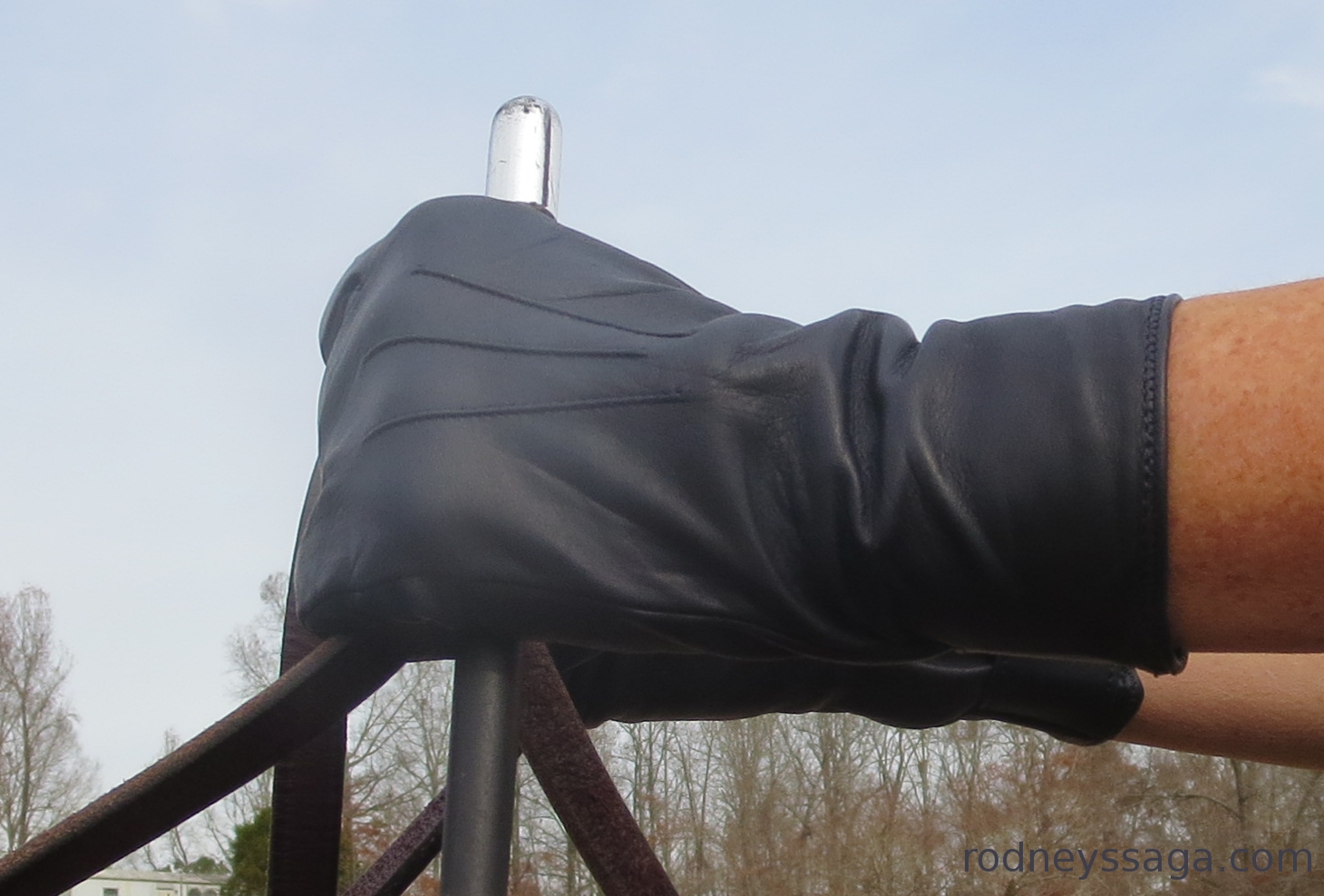
Long show gloves from Hartmeyer Saddlery.
Photo by Courtney Huguley
These are the same folks who talked me into my colorful show outfit [Show Photos]. I may be developing a favorite saddle seat store. Who would have thought?
I bought black gloves for show, navy blue for schooling. Two pairs of black would have been more sensible. I would still have a functional pair if I lost a show glove. OTOH, if it’s not fun, why do it?
Patting Natalie Photo by Courtney Huguley
Extravagant, yes. One might even say excessively extravagant. They were kind of a freebie. I used the prize money from Nationals. Checks in the mail. Hard to get tired of that. The 2014 stationery with 2014 photo.I did not stay for the group picture this year. I was sufficiently tired that I wanted to drive home with as much daylight as possible.
I still don’t like wearing gloves, “When I left eventing for jumpers, I pulled off my gloves with a sigh of relief.” [Repost]. Now I have even more reason not to wear them with my own horses. (If. When.) The gloves, or lack thereof, can remind me which saddle I am riding in. Best not to come over all saddle seat in the middle of a jumping round.
There is a downside to all of this saddle seat riding. I have gotten so adapted to having the horse’s head UP in front of me that the stretchy circle is going to come as a shock.
DRESSAGE DIVISION, page 14
Stretching the Frame … lengthen the reins as the horse stretches gradually forward and downward.
Emphasis mine. The idea is to demonstrate relaxation of the back and acceptance of the bit, AFAIK. For an alternative interpretation and a line drawing of the maneuver, see The Dressage Curmudgeon: The Stretchy Circle. Like the nipples on batman’s suit.
Therefore, one must adjust to the horse’s head disappearing. I discovered this because …
… drumroll …
… I have been sitting on Rodney. The operative word here is sitting. We don’t move, that is the point. We shift into park and watch Milton work. When Rodney buys into the relaxation, he will give a major yawn and stretch his head. Gulp.
We have moved a bit. One day, we did a set of weave poles. This was a conflict for the poor horse. He loves his poles. (Really, really, loves them. To a pornographic degree. Although he has stopped flirting with me. [Speciesism]) He is less enamored of riding. He is not at sure what to think of riding 😦 through poles 🙂 . As with with all things Rodney, the work is 99% mental.
Milton has been lunging. Yeah Milton. He also long-lined. It did not go well. Green horse, green driver. Nothing to see here. Move along.
Truck and trailer have both moved. Next step is power-washing, lights, & a test drive.
The Chronicles of the $700 Pony
by Ellen Broadhurst
Half Halt Press 2006
To help with your holiday shopping, here are copies of an out-of-print book available directly from the author. If she won’t brag on herself, I will. The book is hysterical. Don’t believe me? Check out an excerpt for yourself, The $700 Pony Goes To the Vet. Cracks me up every time I read it.
I believe in the book so much that I am having a giveaway. Comment below. When the dust has settled, I will use a random number generator to pick a winner. One straight-up “Hello World” comment allowed per person. To make it interesting, additional comments and thus additional chances will be permitted IF the additional comment contains an amusing anecdote, heartwarming story, or compelling reason why you deserve the book the mostest. To recap, everyone can enter once with a simple comment. More entries require more work.
Welcome Ellen:
It’s that most wonderful time of the year! The time of the year when our attention turns to keeping our toes and fingers frostbite free, ridding our undergarments of clipped horse hair, and finding just the perfect blend fats, carbs and proteins to keep our equine friends fat and happy, but not too sassy. All that, and shopping for the holidays. I don’t know about you, but I am spending way too much time looking for the perfect gift for my circle of horse crazy friends.
Horse mugs, we have a few, horse shirts, we have outgrew, and those fun horse shaped treats, well, it’s time for something new! I have been invited here today, in fact, by my friend Katherine, in order to suggest something entirely different for this year’s holiday stocking: a book. But not just any old horse book; not an über serious George Morris tome that might actually help you with your riding, nor a practical encyclopedia that would help you identify that funky bit you just found underneath the stinky dog blanket in the back of your truck, not even the slightly befuddling Cleveland Bay and Yorkshire Coach Horses designed to I don’t even know what. No indeed, I am here to suggest something light hearted and fun for those long, cold winter nights: The Chronicles of the $700 Pony.
The basic premise involves a woman, a newspaper ad for a cheap pony, a check book and a trailer. Surely that sounds like a combination that has the potential to be entertaining? Chronicles of the $700 Pony is meant to be hilariously funny, but as the author, it’s more than a bit awkward for me to blow my own funny bone. Reader reviews on Amazon, though suggest that others have found it amusing:
Reader Dr. Laura DVM, says: “So, what can you say when a book already has a 100% 5 star rating??? You will wet your pants. We have all had a $700 pony of some ilk or another and this is the story we would have written if we were as witty as Ellen Broadhurst. For those who might not have had a $700 pony, you have missed out on a major equestrian rite of passage. This book would then be required reading – it’s the closest to the real thing you are going to find.”
Reader Bob says, “The Chronicles of the $700 Pony is Dave Barry/Erma Bombeck meets the horse world. It is one of the funniest books I’ve ever read. Absolutely laugh-out-loud hysterical. The cover should be stamped with the warning: DO NOT EAT OR DRINK WHILE READING THIS BOOK. I had to learn this the hard way.”
So, if you have been wondering what to get your best riding buddy for Christmas, I’d be happy to send you an autographed copy of a very funny book.
Click here to vote for me as blogger of the year. Thank you!
Huge thanks to Haynet for running the contest. I bet it was more work than we realize. Such things always sound easy in theory. Then become a hairball in reality.
For the rest of you, in return for listening to my incessant vote groveling, a gratuitous donkey photo:
Donkeys on Rodney’s Saga Roadside Attraction. These are from the same farm as above. Probably at least one of the same beasts. I can’t tell. Not up on my donkey identification. The donkey farm is near the Saddlebred barn. Not alway to good effect, “The day she saw two donkeys was almost life changing for her.” Guest Post: California Girl becomes a Southern Belle
Continuing to repost the entries from my previous monthly blogs Back To Eventing and Back To Riding. This was originally posted on the USEA website 2011-01-18, archived here.
Future me: This when the rot set in. In truth, the rot set in gradually. This is where I acknowledge it. Up side: this is the beginning of Jean Abernethy’s brilliant illustrations. The one below appeared with the original post, but got lost on the way to the archives.
Back To Eventing: Back to Square One
(The author despairs that she will ever return to Eventing.)
“We have a long-standing joke that when a horse is going well, it’s because it’s being well ridden, but when it’s going badly, it’s because it’s not being fed properly.”
Our mad dash to victory has taken a detour. When New Horse arrived, I knew there would be issues. He is big-strided and responsive. I had spent the last handful of years puttering about on a retiree. I did not imagine that we would saddle up and start showing. I did expect that by now we would be having regular dressage and jumping lessons and be shipping to cross-country courses for schooling. Instead, we are lunging and doing hillwork in hand. The reason we are so far behind the curve arrived in a bag of feed.
New Horse was on a feed not available where we are. What to switch to? Other Horse (future me: OH=Mathilda) is low-maintenance yard art who eats a handful of whatever is on offer. Previous Horse ate super-digestible feeds since he inhaled his food to the extent that bits of it passed through whole. New Horse was neither old nor a vacuum, so hubby and I settled on a new feed for sport horses. I’m sure it’s a marvelous feed, if one is conditioning a horse to go Intermediate. For an A.D.D. Thoroughbred, even a handful was too much.
In retrospect, the problem is obvious. At the time, all was fog and frustration. The horse had shown a bit of temper during try-out. Was it this tendency writ large? Was he more horse than I could handle? He has scarring on his back from an injury as a foal. Was this tightening up?
He grew less and less manageable. Sometimes he would spook and then have a come-apart. Sometimes, he’d have one for no reason at all. As long as it was simply an enormous crow-hop in a straight line, I could rally the nerve to kick him forward. When he added the buck and the spin, I had to grab mane, wrestle him to a stop, and hyperventilate for a while. In addition, the fits developed an unhinged quality that shook me a little more each time.
He finally dumped me. As soon as hubby was around to watch and dial 911, I got back on. We had a pleasant, relaxed walk halfway around the ring, whereupon he tripped over an invisible wrinkle in the ground and had a complete cow about it. We walked gingerly back to the mounting block, whereupon I called it quits.
Of course we considered what he was eating. We cut him back to the point that he began to lose weight. Yet he continued to misbehave, even in hand. When we finally blamed the feed itself, we switched him over to the equine equivalent of rice cakes as fast as good horsemanship would allow.
After detox, he is much, much better. Unfortunately, the psychic damage is done. If the poor horse twitches an ear, I assume he’s about to levitate. To rebuild, we are back at Horse 101. He is on lunge-line probation until he walks, trots, and canters to my satisfaction. The hillwork gives us time to get acquainted and to get in shape together.
In celebration of our new beginning, New Horse has been renamed Rodney in honor of jumper rider Rodney Jenkins. Watching Mr. Jenkins and his marvelous horse Idle Dice at Madison Square Garden was a highlight of my Manhattan childhood. Rodney-the-horse will show under the name Perpetual Motion, which is his nature even on a low-excitement feed.
Future me, again: The name Perpetual Motion was never sanctified on a Coggin’s. It did not survive the introduction of his ulcer medication, “Once we finally sorted out his meds, he calmed down – for a relative, Thoroughbred definition of calm – so PM was out.” [Help Me Name My Horse]
Click here to vote for me as blogger of the year.
Thank you!
Photo courtesy of Haynet contest announcement.
Last few days to vote for Haynet’s Blogger of the Year. (Me!) “Voting closes on Monday 8th December with the winner being announced later on that week.” I assume this means Monday at midnight UK time, which means evening in the US. Vote on! Announcement will appear in this space the day after the official announcement. (Paragraph updated.)
Haynet asked for a few words on the content of the blog & why I write it. Here’s what I sent in. It appeared on the Haynet site as Meet A Finalist. (Haynet readers: apologies for the redundancy.):
Before blogging, I never wrote for free. Rodney’s Saga started as a monthly column for a US eventing magazine. After it lost steam, I continued on my own, for reasons that seemed like a good idea at the time. At some point, I became addicted. A touch of obsession is useful for cranking out a daily blog. Tired? Late? Nothing to say? Does. Not. Matter. Must. Write. Post.
Of course, I have Holodeck fantasies of my words going viral. Until then, I enjoy solving the puzzle of what to say each day. Plus the entertainment of reading other horse blogs and making virtual friends. In the comments, I have received useful advice, personal stories, even the occasion kick in the pants.
As for my horses … sigh … I have two fabulous horses. I don’t ride either of them. The blog is my attempt to keep the faith in light of my immediate future as a horse petter.
Maybe the blog will lead to marvelous opportunities, writing or otherwise. Maybe it will just keep me from bouncing off the walls as I wait for my horses to sort themselves out. Either way, good deal.
In the spirit of fairness (and shamed into it by Tails from Provence: Motivation), I present the other 11 finalists: