Meanwhile Back at the Ranch: Feed

At the beginning of the year, we raised Milton’s rations significantly [Miseries: Feed Me!]. He improved. For a while. Then stalled. His attitude was more pleasant, but still grumpy, “He’s never going to be a ray of sunshine, but he’s less vile-tempered.” He disliked being groomed. I was annoyed with him. Our blacksmith thought he looked skinny. There was nothing major or specific, just a collection of minor irritants. In short, he wasn’t thriving. We needed a change. My in-house nutrition advisor decided to try switching feed.

Milton had been on the same highly-digestible senior feed that Rodney has been on for years. We were given to understand that Milton was relatively uncomplicated, feed-wise. We figured as long as he was getting adequate nutrition, he would be okay. Milton certainly isn’t the festival of digestive issues that Rodney has been [Zeno’s Horse Training]. Still, a new feed is an easy change for us. One of the benefits of having horses at home. We went back to a name-brand, 10% sweet feed that Mathilda always ate and that Previous Horse ate for years before he went senior.

(Mathilda did not do senior feed, thank you very much. She was even picky about where her sweet feed came from. Seriously, in the winter, her national brand food had to come from store X rather than store Y or she wouldn’t eat it. No one at either store could tell us why there was a difference. But I digress.)

Voila, happy horse!

Milton no longer greets the world with default, ill-tempered unpleasantness. His ears are up more often than not. He is less pissy about being groomed. Blacksmith thinks he looks good. Even Rodney has noticed. The horses are more likely to be found grazing closer together. Rodney still moves away from Milton, but no longer leaps like a startled bunny when Milton looks in his direction. (A 17-hand horse leaping like a s.b. is quite a sight. But I digress again.)

More food having a positive effect I can understand. Calories is calories. Digestibility, I can also get behind. Different food having such a big mental effect? Not so much.

As for the rest, yes, yes. Believe me, there is nothing you can say on the subject of Milton about which I am not already berating myself.

Feed changes, your experience?
~~~
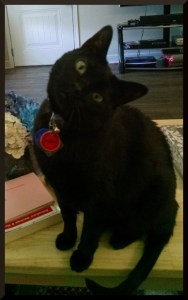
Gratuitous Cat Photo

Percy
Percy

Mardi Gras Parades, A Guest Post

A friend from my three-dimensional life, Michelle Duplichien, makes an annual pilgrimage to Mississippi &/or Louisiana for Mardi Gras. This year, she was kind enough to take pictures of the horses she saw there. Welcome, Michelle.

It was February 17th and very, very, very, cold.

100_2346

There were two riding groups in this particular series of parades. I only caught the back of the New Orleans Cowboys (just the one pic of the group with burgundy jackets).

100_2337

Most of the horse photos were of the Urban Cowboys.

100_2339

The location was Metairie, Louisiana on Veterans Blvd. Here’s a map of the route for visual simplicity.

Parades have names and most of the time it is based on the krewe that organizes the parade. On this particular day three parades rolled on the same route consecutively. The parades were Argus, Elks Krewe of Jeffersonians, and then Jefferson Trucks (a parade of floats pulled by semi-trailer trucks). I’m fairly certain the Urban Cowboys were part of Argus.

Most groups try to do multiple parades. That goes for both walking groups and floats independent of a parade krewe. Usually walkers in a traditional float parade represent some organization whether it be amateur or professional. Besides traditional floats a parade can have marching bands (a good parade has multiple), dance studio groups, bands, and baton twirling groups. I can’t forget these guys, The Mobile Mystics [scroll down for photo]. They pass out paper flowers to ladies for the price of a kiss on the cheek. The previous list is not exhaustive of all that can be seen in a parade as each parade is unique. There are also parades like this one listed under the January 6th banner on Mardi Gras Parade Schedule.com.

The minions were on a float in the same parade.

100_2333

Horse groups are not called floats. Think of floats as a mobile object meant to pull a group of people.

The parade style varies from location to location. The parades I experienced in Mississippi were very simple compared to those I saw in Metairie. The New Orleans parades are the most epic of all. To put it in to perspective, Mississippi parades had simple decorated, rolling “boxes” as floats compared to the elaborately decorated, seemingly sculpted New Orleans floats.

The following pictures are from the beginning of a parade in Gulfport, Mississippi. All parades begin with law enforcement vehicles with loud sirens usually followed by the organizing krewe’s banner and then military members carrying flags.​

Repost, BTE 9 of 9: Forward Planning

Continuing to repost the entries from my previous monthly blogs Back To Eventing and Back To Riding. This was originally posted on the USEA website Thu, 2011-06-09, archived here. Illustration by Jean Abernethy.

Not only my last Back To Eventing column but my last assignment of any kind for the USCTA/USEA. I wrote for their magazine for many years, under both names and several editors [Summary]. By the time the column was canceled, the magazine had a new, young editor who was bringing in her people to do their thing. Oh well, shift happens. I picked up my typewriter in my arthritic paws and tottered off into the sunset.

April finished art revised 2 j

Back To Eventing: Forward Planning
(A series on – slowly, slowly – renewing one rider’s eventing career)

“Even if you get knocked down, pick yourself and keep trying to be the best you can be despite the odds.” Joe Fargis

“Follow your dreams even if they seem impossible.” Mary King
from How Good Riders Get Good by Denny Emerson [Trafalgar 2011]

As of April 1st – 161 days to the American Evening Championships 2011

The Clinic
I’ve done something very stupid, very brave, or very both. I’ve signed Rodney and me up for a Jimmy Wofford clinic in October at Foxwood Farms. I have signed up for an eventing clinic with a horse I can’t ride who has never jumped a cross-country fence. I figure that in the next six months, we will have made:

A) No progress. My fancy new horse will have turned into a 1400-lb pasture ornament. In which case, I will be fit company for neither man nor beast.

B) Little progress. Riding, but not enough to participate. In which case, I will audit the clinic and chug Maalox out of frustration.

C) Great progress in the wrong direction. We will have evented several times, and he will have let it be known that he would rather be a Show Jumper, thank you very much. In which case, he better have decided to be a darned good one.

Or, theoretically possible,

D) Great progress. We will have evented several times, forming the start of a wonderful eventing career of which the clinic will be an educational and entertaining step. In which case, hubby will have sprained his jaw from saying I told you so.

The Event
In a similar spirit of optimism, hubby and I checked out cross-country day at a local event. One or two of the Novice fences elicited eyebrow elevation. However, Beginner Novice is mostly variations on the theme of log. Add a ditch with no depth, terrain, and a trot through water and we’re good to go. This doesn’t preclude a bilateral meltdown when we come out of the start box, but at least the concept is feasible.

Back when Novice was called Pretraining, I dimly recall attending my first event on a green horse without a clue between us. We’d done zero formal cross-country practice before showing up on the day. On the other hand, I was boarding at a 1000-acre farm. We were on the trail more often than in the ring: galloping through mud, jumping pasture fencing, and doing all manner of other things we should not have been doing. I promise not to turn into a nostalgic curmudgeon constantly yapping about how it was back in the day. If you were there, you know; if you weren’t, you don’t care. I bring up the past to illustrate that I will need to deliberately recreate that background by shipping to trail rides, riding in hunter shows, visiting other barns, and jumping lots and lots of cross-country schooling to prepare for my first event this time around.

Back in the present, one highlight of the day was meeting the titular heroine of The Chronicles of the $700 Pony & The Further Adventures of the $700 Pony [Half Halt, 2006 & 2008] written by Ellen Broadhurst and illustrated by Patricia Naegeli. When reading, ya gotta wonder how much an author embellishes for effect. I can report that Pony-in-real-life has just as much attitude and just as much beautiful tail. Pony’s adventures continue in a blog by her new rider, Marisa Goode. Broadhurst now blogs about her family’s life abroad.

One low point of the day was the horsemanship. At the risk of reranting, after cross-country – GET OFF YOUR HORSE. To the riders who did, thank you. To the ones who rode back to the barn on hot and sweaty horses, who do you think just did all the work out there!?!
—–
To access back columns in the USEA archives, check out Rodney’s Facebook page: Rodney aka Perpetual Motion.

(Repost ends. Back to current comments below)
~~~
I wrote about the Wofford clinic later that year: Weekend with Wofford.
~~~
The Further Adventures of the $700 Pony is available on Amazon as an ebook.
~~~
The Goode & Broadhurst blogs are defunct. As is my Perpetual Motion Facebook page.
~~~
Rodney’s Saga repost locations
BTE 1 of 9: How I Won the Training Level AEC
BTE 2 of 9: The Cast Assembles
BTE 3 of 9: The AEC, a Realization in Five Phases
BTE 4 of 9: New Horse Blues
BTE 5 of 9: Buying the Horse is Only the Beginning
BTE 6 of 9: Back To Square One
BTE 7 of 9: Getting to Know You
BTE 8 of 9: Spring Fitness
Or
List of all nine direct USEA links

Show Tweets: Pro Am 2015

I know my mom reads my show tweets (waves hi!). Therefore, I thought this would be a nice way to signal the start of a tweet series. A bookend to the “Home safe” message.

#horse. I kept forgetting to add the hashtag.

Show Report: Pro Am 2015, On Being Muddled

Stepping Stone Farm Ribbons

Pro-Am Benefit Classic Horse Show of Georgia
April 1-4, 2015
Georgia National Fairgrounds & Agricenter
Perry, GA, USA

Saturday, April 4
111. Academy Equitation WTC Adult, Trump, 2nd of 4
112. Academy Showmanship WTC Adult, Trump, 1st of 4
120D. Academy WTC Championship, Roberto, 6th of 11
Thank you to Ashlyn Seagle and Reagan Huguley for the awesome horses.

Show Photographer Doug Shiflet. My photo download rant, including a message from Mr. Shiflet. Intellectual property, it’s a thing. WIPO

After the performance classes, Sam decided he was done showing for the weekend. I would ride Trump in the regular classes and Roberto in the championship. I had to jettison all the preshow visualizations of the clever maneuvers I was planning to execute [Show Today: Pro Am]. Instead, I began to worry about the show when I failed to get my canter leads with Trump [Report: SSF] and about the pressure of riding my coach’s horse.

The show was not my finest hour:
Me: Was my first class as bad as I think it was?
Coach: Yes.

In hindsight, I blame the leg lessons [Repercussions]. For the last three Wednesdays, I had joined the group equitation lesson. We did no-stirrup work, sitting trot, two-point, and so on. It worked. At the show, I felt balanced over my feet. My upper legs were tighter on the horse. I was able to dig my knees in and swing my lower legs away as required in saddle seat.

Unfortunately, these improvements came at the expense of every ounce of saddle seat from the waist up. We had thought we might be able to mitigate the damage. I didn’t look too bad in lessons. Even in warm-up, I had moments. However, once I went in the ring, the small changes opened the door to allow decades of showing in other styles to swamp my tenuous grasp of saddle seat showing.

The trot wasn’t immediately awful. In Mr. Shiflet’s photo 112-008-PA15, you can see I am trying to lift my hands & look up. However, the saddle seat window dressing is having no influence on my core forward seat position. I’m not unhappy with the body position. It looks balanced. It looks strong. It just doesn’t look saddle seat.

At the canter, my bad habits came roaring back. Suddenly, I was leaning forward to get the canter and thundering around once I’d gotten it. Pitching one’s weight onto the horse’s front end is not a useful signal in any discipline. It is particularly unuseful in saddle seat. The rider is expected to stay back, out of the way, so that the horse can be light and fluffy in the shoulder. In addition, saddle seat judges expect a horse to execute a contained, dynamic canter, not to gallop flat out as if making up time during the run-in after the last jump on cross-country.

Furthermore, I was out-of-proportion upset by the switch in horses. Why? Trump is a sweetheart. Roberto is a blast to ride. I posit that being physically muddled led to being mentally muddled. Therefore, by extension, physical confidence influences mental confidence. Score one for mind/body unity versus mind/body dichotomy.

No more leg lessons. This is not an excuse. A few exercises should not have caused me to fall so completely apart. However, it is an action item. I had a bad show. I have identified an avenue to get back on track.

I think (I hope? I wonder? We shall see.) that I will be able to continue with saddle seat if (when!) I start riding my own horses. The Thoroughbreds will be ridden in suitably Thoroughbred styles in suitably Thoroughbred hunter/jumper or dressage saddles. Saddle seat time will be reserved for saddle seat riding. The problem comes when I execute alien maneuvers, i.e. two-point or sitting trot, in saddle seat.

Don’t cross the streams.

Update: Coach’s Comments
While my Coach does not disagree with the theories above, she thinks my problems at the show stemmed mainly from not adjusting to the last-minute horse swap and to stressing about getting my canter leads with Trump. She says it’s all in my head. She’s not wrong.