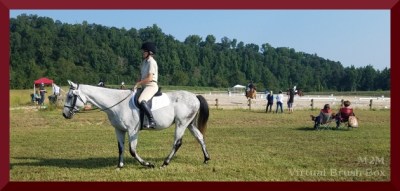
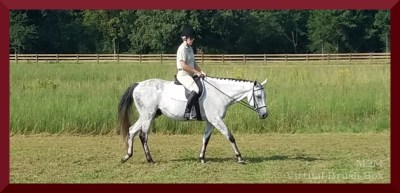
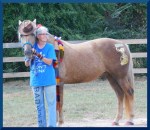
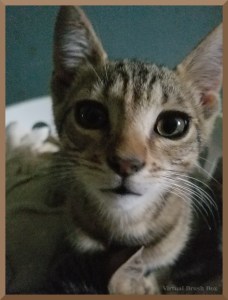
We took Milton to Full Circle Horse Park to walk over the teeny, tiny Amoeba-level jumps. Despite my snarky title and the half-mast ears in the photo, Milton’s attitude was the perfect combination of stepping quietly over the little logs and marching happily around the field.
He paused in front of one jump, as if to consider whether he could indeed step over. As I sat there considering my next move, he decided that Yes, he could and over we went.
We trotted about the countryside, we trotted away from a few fences, but did not trot AT any jumps. I didn’t want him to get overexcited and land in a rampage. He’s done that on the lunge line.
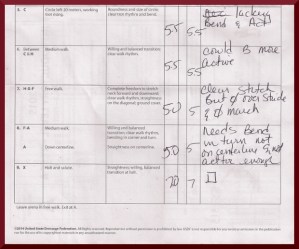
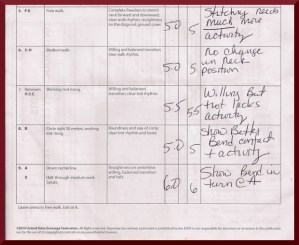
He spooked once. At the platform where the dressage judge sits. After which, he crawled around the dressage ring at a snail’s pace.
Likes XC. Hates dressage. Looking more and more like an event horse.
My first time on cross-country in … I don’t know … how long ago did they stop having penalty zones? My first time on cross-country with Milton. Our first time passing through red/white flags together. Our first time standing in a start box.
We were at Midsummer back in 2013 [Show Report]. I was still in Academy Walk-Trot. First and second place riders from the regular classes rode in the championship. Since Alvin & I won the first class, I had the opportunity to hot dog in the second class. I was feeling full of myself.
Picture us at the ingate. Alvin calmly waiting to start. Me bouncing about excitedly.
Me: Let’s go! Let’s do this thing! Rock and roll! Saddlebred sizzle time! Show ’em what you got!
Alvin: No. If I gave you what I got, you couldn’t ride it. I’ll give you what you are ready for.
Me, meekly: Okay, sir. Yes, sir. Thank you, sir.
2013 Sandra Hall Photography
“For this (the championship) victory pass, I remembered to stay upright when Alvin kicked it into gear. I was rewarded with a few steps of real Saddlebred motion. His shoulder lifted about six feet in the air, the whole front of the horse got light & fluffy, and suddenly I had this contained explosion going on in front of me. It felt as if he was on two wheels, but in a good way. Wheeee-ha.” [Show Report]
Me: It’s such a loooooong drive.
Voice of Reason: You had a nice ride and good company.
Me: We had to get up soooooo early.
VoR: Nap in the truck.
Me: We were the cones division.
VoR: The course was set up when you got there. You didn’t have to take it down. You had to place the marker balls on the cones. That was it for set up.
Me: We had to measure and change cones and time and judge and … and …
VoR: You had help.
Me: We had to make microscopic adjustments to each set of cones for (almost) every driver.
VoR: It was 8 entries.
Me: It was hot.
VoR: They fed you.
Me: We had one entire obstacle to do all by ourselves
VoR: Think of it as cross-country with wheels.
Me: Our knowledge of marathon judging is largely theoretical.
VoR: Schooling shows are for training volunteers as well as competitors
Me: I don’t like being in charge. I don’t like the responsibility.
VoR: To quote Dr. Hofstadter, “Well, you should work on that.”
Me: I only have a moderate interest in driving to start with. When Husband isn’t driving, my interest drops quickly.
VoR: So you spend the day helping other folks realize their dreams. This is a problem?
Me: It’s a lot of work.
VoR: People did it for you last year.
Me: Bitch. Whine. Moan.
VoR: Suck it up, Buttercup.
The Saddle Seat World Cup is focused on the equitation division. For people who are not familiar with Saddle Seat or who are just not as familiar with equitation, here is my guide to equitation.
Any new comer to the sport of saddle seat needs to be introduced to Equitation discipline. Equitation can be defined as the art and practice of horsemanship and horse riding. Let’s think about that statement for a moment. The “art” of horsemanship… Watching a rider gracefully maneuver their horse across the ring, while maintaining perfect form is elegant and absolutely breathe taking; it’s poetry in motion. Equitation riders not only have to show their horse to the best of the horse’s ability, but they also have to make it look effortless. If a rider can master the art form of Equitation, then they have set themselves up to be an expert horseman.
When watching an Equitation class for the first time, the beginner spectator must know what to look for when observing. The exhibitors are to be judged on their ability to ride the horse, not on the horse’s athletic ability. Although the horse is not to be judged, the rider will be judged on how well he or she is showing the horse and how well he or she looks while doing it. Is the rider riding the horse to the horse’s potential? To show a horse well, he or she should show their self to the best advantage. A rider with perfect form that hides quietly on the rail may be penalized for not showing proper horsemanship and taking command of the show ring.
Proper form. The rider’s hands should be held above the horse’s withers. The height of the hands should be determined on where the horse carries his head. The rider’s hands should be parallel or slightly above parallel to the bits in the horse’s mouth. The hands should appear soft and show control of the horse at all times. The rider should sit comfortably in the saddle. The rider’s seat should not be too far back where they are sliding off the saddle nor too far forward where there is excessive saddle space showing. There should be a slight bend in the knee and the stirrup irons should be directly under the ball of the foot. The rider’s heels should be down and the foot position should appear natural. The toes should not be pointed out or rotated too far inward. While in motion, the rider should have a slight elevation when posting at the trot. Posting should be a fluid up and down motion and never appear mechanical nor should the hips thrust forward or backwards. When cantering, the rider should not rock their upper body, but their seat should move with the horse.
What to wear? It is not mandatory to have a multi thousand dollar suit, but neatness is required. Regardless of the material the riding habit is made out of it, proper fit is key. Equitation suits are not meant to be flashy. The rider’s suit should not distract the judges from the rider’s ability. The Equitation division has stricter rules on attire versus other Saddle Seat divisions. Equitation suits must have a jacket with collars and lapels of the same conservative color with matching jodphurs. The conservative collars include black, blue, burgundy, green, beige, or brown. There are no exceptions to this rule. After 6:00pm, riders are allowed to wear formal, tuxedo-type, habits. Any rider that does not have a matching jacket and pants or has a habit that is not a conservative color will be penalized.
I have shown in the Equitation division for over 20 years. It is my passion. I love that I am in complete control over the outcome of my class. If I do not have proper form, if I am too conservative in my ringmanship, if I do not execute my workout properly, then I will be penalized. In other Saddle Seat classes outside of Equitation, you can practice all you want but sometimes there is still a nicer horse out there that will beat you regardless of your hard work. With Equitation that is just not the case. The more time and effort you dedicate to the sport, the more you perfect your form, the stronger you become, the more in sync you become with you horse and your ribbons will reflect this hard work. This is coming for a trainer’s kid that never had the expensive horse and still found success in the show ring beating the nicer horses. The equation for Equitation is hard work + passion + dedication = success. This math has been tested and will work every time.
For World Cup, I won’t be competing on my horse and am required to compete on horses I have never ridden before (with the exception of the 5 minutes of warm-up we are allowed). So, practicing equitation for World Cup does require slightly different preparation. I will not been practicing to became in sync with one particular horse, but will be practicing on as many different horses as possible.
~~~
Much of this post originally appeared in
“Equitation”
by Reagan Upton The Equestrian Guide
Published June 12, 2017
Publisher Caitlin Reason
pages 30-31, photo p32
Available at Issuu.com