We have stopped the Purina Outlast [not a post]. Over the years, we have tried so many solutions for sensitive horse stomachs: Outlast, ranitidine [Say Aaaah!/Update], Tums. Maalox, yeast [Tiger Whistle], and a variety of additives that Rodney was on when he arrived. We stopped for various reasons, from lack of availability – ranitidine [Zeno] & yeast [not], to lack of results – the initial goops, to wandering off to try new things – Tums, Maalox, Outlast. Maybe we saw minor changes for the good. Maybe we wanted to see minor changes for the good. Nothing definitive.
The answer is UlcerGard. It works. It’s ridiculously expensive. The rest pale in comparison. YMMV.
When you break your halter and have to wear the spare.
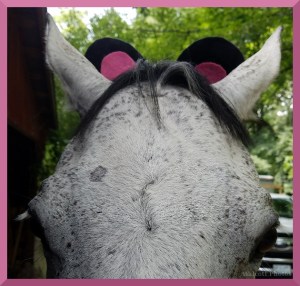
Milton has a red shipping halter. Rodney has a green shipping halter. The spare is black. The spare was used for Alvin’s costume last Halloween [It’s a Rat Race].
Since the job of the spare is to hang on the bridle rack, I left on the mouse ears and whiskers to jazz up the trailer dressing room. Thus was born the Halter of Shame.
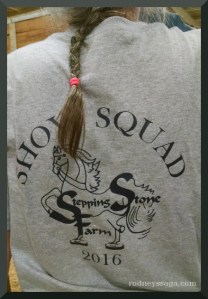
When you are part of a barn, you represent. I am conscious of this every time I put on a Stepping Stone Farm shirt. What if I stop by the bank/grocery store/WalMart and have a sense of humor failure? Will that reflect on the barn? This is not me being paranoid. One day, I stopped at the feed store on the way home from a lesson. I bought two? three? bags of feed. Some small number. I was presented with a HUGE bill. Without prompting from me, the checkout clerk had seen the SSF logo on my shirt, added my feed to the barn account, and present me with the total. The barn wasn’t past-due. This was the monthly amount. It costs a lot more to feed 20+ horses than it does to feed 2.
When you are part of a barn, they represent you. At one of the ASB shows, we got in the way of another trainer. Out of an excess of caution, I had closed the schooling arena gates while we hitched Milton. They wanted in. We asked for a moment while we hitched. They were not pleased. Milton behaved & we didn’t take long. After a minute or so, I opened the gates and invited them back in. Too late. We had already ruined their life. Later, they came over to explain the many, many ways we had erred. What interested me was that they did not approach us until Coach Courtney had left. I felt like a feudal vassal, under the protection of my liege lord.
When you are part of a barn, you inherit their friends. I’ve already mentioned that any publicity I get is from being associated with Coach Courtney [More 15 Minutes]. When I started showing, people were friendly to me because I was with SSF. If we had randomly shown up at an ASB show to school Milton, no one would have talked to us. Not to be mean. People would have been occupied getting on with their lives and their businesses. No one has time to befriend every stray who appears at a horse show.
When you are part of a barn, you inherit their enemies. I came out of the ring after a class. I had just won. I was feeling boisterous. We all needed to turn around and head back in for the second class. In the melee, I ended up at the back of the pack. I made enthusiastic noises to inspire the troops onwards. Another trainer (not the one above) told me to wait my turn and not get ugly. Lady, I couldn’t do ugly if I tried. Perky? Yes. Annoying? I’ll grant you. Ugly? I wouldn’t know how. Later, it occurred to me that this person was not a member of the Coach Courtney fan club. Perhaps I was tarred with the same brush merely by an SSF student.
When you are part of a barn, it can be emotionally supportive. You have an immediate group of folks to cheer for and who will cheer for you. You have a reason to spend five days in Lexington, as if I needed the excuse. To this day, I have friends I made in at a barn 40 years ago (waves Hi!).
When you are part of a barn, it can get emotionally messy. Everyone in the horse world has stories of rider-trainer relationships gone sour. Nor it is limited to the horse world. The same misunderstandings happen from ballroom dancing to pastoral care, “I can’t help but think I would have saved myself a lot of pain if I had maintained a strictly professional view of the relationship.” The Girl with the Tree Tattoo: There’s Being Friendly, and Then There’s Being Friends. It’s not all bad. “Just because your teacher isn’t categorized as your friend doesn’t mean you won’t form a close bond with them.” Ibid. I remind myself of this on a regular basis. Coach Courtney has contracted to teach me to ride. She has not contracted to be my best friend. I am not her life. I am not her family.
Today is day 3 of the Saddle Seat World Cup. The five-gaited team competes Wednesday, July 4 and Friday, July 6 Thursday, July 5. Competition to be livestreamed on the USEF Network. This post was written before the competition began. Good Luck Reagan!
~~~ Clothing comparison: USA left. SA right. 2016 World Cup competition in Stellenbosh, South Africa, Three-Gaited section. Photo by Christy Parker
Questions by KTW
I know a little about the international aspect, but I won’t pretend to be an encyclopedia of knowledge.
What countries?
United States of America, Canada, South Africa, and Namibia will all be competing for the 2018 Saddle Seat World Cup
How long have they had saddle seat?
I am not exactly sure how long each country has had saddle seat. The Saddle Seat World Cup has been going on since 1996. The two countries that competed in the first competition were USA and South Africa. Canada began competing in the World cup in 1998 and Namibia started in 2004. Other countries that have previously competed but won’t be attending this year’s competition are Germany, Sweden, and Great Britain.
Are there different saddle seat styles in different countries?
I haven’t noticed different styles from the previous international competitions I’ve watched. The art of equitation is universal and is the same in each country. I have noticed the riding attire trends are a little different. USA’s riding suits tend to be flashier with shiny fabrics and the South Africans like mismatched derbies. They might wear a tan derby with a black suit or and dark brown derby with a tan suit. The mismatched derbies are something you don’t see here in the states. In my (probably biased) opinion, the USA riders always have a more polished, tailored appearance.
Do other countries come over to ride at Louisville?
Louisville is still our big Kahuna but the international barns don’t typically travel to the USA to compete at our “World’s” Championship Horse Show. There have been a lot of native South African trainers that have moved here and opened barns in the USA, but there isn’t much international saddle seat competition outside World Cup.
Who usually wins World Cup?
United States is definitely the World Cup powerhouse. USA dominates the three-gaited division and has only lost to South Africa a handful of times. The five-gaited division is more evenly matched. Both USA and South Africa are very competitive in the five-gaited division. South Africa actually has Five-Gaited Equitation at their horse shows where the USA does not. So, five-gaited equitation is something the South Africans practice on a consistent basis even outside of preparing for World Cup. Virtually every World Cup competition, USA and South Africa are competing for Gold and Silver and the other countries are competing for Bronze.
Tell us about the International Saddle Seat Equitation Association.
The International Saddle Seat Equitation Association (ISSEA) is the governing body, which is composed of countries that are uniting with the common goal of promoting and growing the Saddle Seat Equitation discipline on an International level. ISSEA is the organization that controls how the World Cup competitions are run, the judging criteria, patterns that will be performed, and is responsible for selecting the judges.
How will this be different than any other horse show, or will it not be? I once interviewed an Olympic eventer who said the whole point was this it wasn’t different. You went in & do what you do.
The actual riding and execution of patterns will not be different than any other horse show. I will still ride and show the horses in the exact same way. The difference is how everything is scored. The judges do not tie the class in the same fashion as a regular show (1st – 8th). The judges have to assign each rider a numerical score from 1-100. The rider’s individual scores are then calculated and combined with the other riders from the specific country. The scoring gets a little complicated and could be its own post.
Today is day 2 of the Saddle Seat World Cup. The five-gaited team competes Wednesday, July 4 and Friday, July 6 Thursday July 5. Competition to be livestreamed on the USEF Network. This post was written before the competition began. Good Luck Reagan!
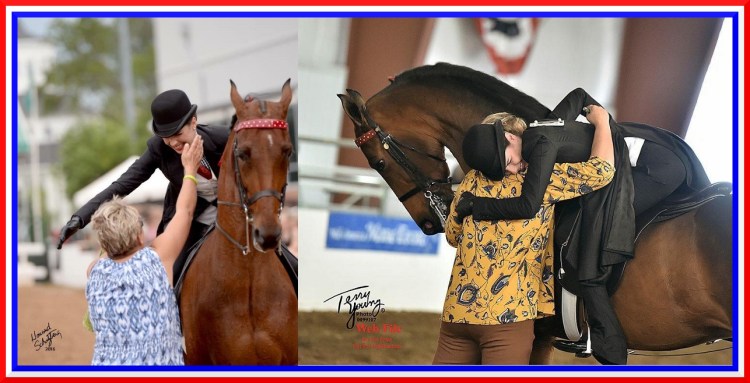
~~~ The Mother-Daughter Victory Hug
People have asked what I will be doing all week outside of riding horses. They have many activities planned for us.
All the riders are required to be at the competition by 5:00pm on Sunday July 1st.
Sunday night, we will have a dinner for Team USA and supporters.
Monday, we will be hosting a Welcome Reception for all the teams and supporters.
Tuesday, the competitors from all countries will be attending the Lexington Legends Minor League Baseball game.
Wednesday morning evening is opening ceremonies and we will have a USA only team dinner that evening.
Thursday afternoon all teams will be touring the Kentucky Equine Sports Medicine and Rehabilitation Center (KESMARC)
Friday night is closing ceremonies (Schedule unclear on this point as of 7/2. At least, unclear to me. I assume someone knows. But I digress. KTW) and a dinner for all competitors and supporters.
What’s going to weird about this week is the parents are not allowed to participate in the majority of activities. My mom is not only my mom but my trainer/coach as well. So, it is going to be strange not to have her around.
Parents and supporters are only allowed to attend Sunday and Monday’s dinner and the opening and closing ceremonies. Parents and supporters are also not allowed to stay at the same hotel as the team. I assume this is to keep the team focused and encourage team bonding. It also gives it an “Olympic Village” type feel to the required separate lodging.
I am hoping to hang out with my family and everyone from Alabama that comes to the competition to watch on Thursday while I am not competing. The three-gaited team will be competing on Thursdaywill compete while the five-gaited team sits and cheers them on. So hopefully, we will be allowed to sit in the stands with everyone else. (I have been told that both teams will compete Wednesday & Thurdays nights. Hopefully we will get to cheer with Reagan while the three-gaited team competes, regardless of the day. KTW)
I will let all of y’all know how the activities went!
Today is day 1 of the Saddle Seat World Cup. The five-gaited team competes Wednesday, July 4 and Friday, July 6 Thursday, July 5. Competition to be livestreamed on the USEF Network. This post was written before the competition began. Good Luck Reagan!
~~~ Team Gear
It wasn’t until my recent years that I decided to add being on Team USA to my bucket list. I’ve always thought it would be super cool to be on the team, but it was only a few years ago when I decided this was something I really wanted to achieve.
World Cup is a bi-annual competition. In 2016, I considered trying out for the team, but decided not to when I found out the competition would be the same week as my national championships. I chose to compete at Nationals. Turns out that was not a bad decision. I won both the Adult USEF Medal and UPHA Adult Challenge Cup unanimously that year.
When 2018 tryouts came around, I decided it was now or never because I was not getting any younger. I was invited to tryout and made the team. For some reason, until lately, my sense of accomplishment ended after I made the team. I thought “Yay, I made the team and now I get to add being USA World Cup team member to my riding resume”. Once I made the team, I was preparing for the competition as if it was another horse show. Ride your horse. Kick ass. Rinse and repeat. People would ask if I was getting excited or nervous. My internal response was always “not really… it’s just another competition.”
It wasn’t until recently when someone (our beloved Katherine) told me that she thought I was too close to it to see how unspeakable cool the whole thing is. And you know … she is right. World Cup is the only international saddle seat competition. It is basically the saddle seat Olympics. The United States Equestrian Federation (USEF) treats the saddle seat team the same as they do their Olympians for other disciplines. We get the same attire as the Olympians and considered a legitimate part of Team USA. That is pretty freaking cool!!
I am now recognizing and letting it soak in how rare of an opportunity this is and how this is not just another competition. I am representing my country and that creates a sense of pride. That also creates a sense of fear. If I don’t ride well I won’t just be letting myself down but I will also be letting my country down.
So if someone were to ask me now if I am getting excited or if I am getting nervous, my response to both would be “HELL YES!”







 Virtual Brush Box