Technical error or accident art?

Horses & Other Interests
Technical error or accident art?
 Today, I am a publicity stop on the virtual book tour for Noor. Book by Milt Toby. Tour arranged by Walker Author Tours. Welcome Milt:
How Much Research is Too Much?
Research is the lifeblood of the non-fiction books and magazine articles I write about horse racing, but it’s also an important tool for fiction authors. Readers are more knowledgeable than ever before, and what they don’t know they can find out in a few seconds on the Internet. And when readers discover a mistake, they’re almost never shy about letting you know.
An astute reader of my latest book, Noor: A Champion Thoroughbred’s Unlikely Journey from California to Kentucky, emailed to let me know that she liked the book. A longtime racing fan, she also pointed out a few factual errors for which there’s no good explanation. I know that Middleground defeated Hill Prince in the 1950 Kentucky Derby, for example, but inexplicably I referred to Hill Prince as a Derby winner.
 It was humbling—and incredibly annoying—to realize that mistakes made it unscathed through all the revising, editing, and proofreading that go into writing a book, but I appreciated the email because the mistakes can be corrected in a second printing. An unexpected bonus: I may have found a new expert proofreader for my next book!
Good researching is a skill, but it’s also an art. I’m fortunate to live a few miles from the Keeneland Library located at the historic race track of the same name outside Lexington, Kentucky. Combine a library staff that is both expert and incredibly helpful with one of the best repositories of racing history anywhere, and it’s a writer’s dream. One of the great joys of research is to make connections that no one ever has put together before, and that’s what I try and do in my books. As with most things, however, you reach a point of diminishing returns when you’re doing research. The trick is realizing when enough is enough.
But how do you know when it’s time to quit, when you’ve reached that point where there’s a danger that the forest of Post-It Notes and stacks of paper will take over the project? For me, that point arrives when I begin to include factoids that are interesting and show I did my homework, but don’t really help move the story along. Research is an important part of writing, but it’s only a tool, not an end in itself.
Noor links:
Pedigree from Throughbred Database
Race info & results from Horse Racing Nation

My saddleseat instructor says that 90% of the time, she would rather have someone new to riding than a crossover from another discipline. Ingrained habits are just too hard to break.
I can see her point. As a crossover hunter/jumper/event rider, I am doing okay so far. However, I have always been a theoretical rider, perhaps to a fault. I want to know why my hands need to be doing thus-and-such and what that means for my balance and where my legs need to be. I have been accused of over-thinking my riding. This is just a new set of theories to think about.
In the beginning, I would lean forward and kick with my heels when I wanted the horse to go. I gotten past that, mostly. However, I still revert in moments of confusion. Sam and I were attempting the pattern that the Advanced Adult Class will be doing in Saturday’s show. It involved two-loop serpentines at the trot and canter. Saddleseat riders take their pattern work seriously. This was no lazy set of loops along the ring. The serpentines went across the center of the ring, meaning 10-meter loops at best. Plus, the transitions and the change of direction for the canter serpentine where to be done through the halt. All of this on a horse I that I am still learning to turn. Until now I have been relying on the rail to keep Sam turning left or right.
So, I’ve done my trot serpentine, have halted, and am looking down the barrel of half-circle/halt/half-circle/halt/reverse/trot. I get flustered, bend Sam to the inside, and ask him to canter. Saddleseat horses canter off outside leg/outside rein. Sam does exactly what I ask and picks up the wrong lead, leaving us to do a 10-meter half-circle on a counter-canter. It does not go well.
I can do it when I have time to think about it, but she’s right. When rushed, I fall back on habits of a lifetime.
List of saddleseat posts.
Have you learned a new riding (fencing, knitting) discipline? How did the changeover work for you?
____________________________________________________________________________________________________________________
Gratuitous Kitten Pic
Rhyme likes to ride on my shoulder.
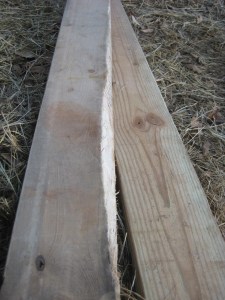
Rodney is not a cribber but he does take the occasional nibble of the removable wooden barriers [Incipient]. Naturally. this is not my favorite of his habits. The silver lining is that the teethmarks tell me which board to put back in the top slot.
Last week, a kind person offered to let me try her firebreathing, American Saddlebred show horse. I said no.
I hate myself.
The gentleman in question was a gorgeous, powerful chestnut who had done well this season, including placing at their big, end-of-the-year, National show. It was an honor to be asked. I wish I were the sort of fearless soul who would get on any horse and try anything. I know I’m not. If I were to force myself, nervousness would be a self-fulfilling prophecy. That sort of gold-plated courage comes naturally or not at all.
It’s not a matter of getting old. I wasn’t particularly bulletproof in my earlier riding days. I had my moments. I did show my friend’s crazy jumper mare. However, it took me seven years to work myself up to it.
My bravery is also horse-dependent. I’d show Previous Horse in Jumpers, but I wouldn’t take Mathilda over a cross-rail. It’s not clear where Rodney falls in the spectrum. In the beginning, I would shrug off his misguided moments. I wrote this in September of 2010 [BTE: Cast]:
Top Ten Reasons You Know You Found the Right Horse
…
& the number one reason YKYFtRH:
1 When he pitches a widget that would incite panic from a different horse, you laugh and tell him to get over himself.
The laughter died off as the antics increased in decibels. On good days, I can face him down with impunity; other days, his size gives him an edge. (In my defense, if Previous Horse had ever thrown a fit on a similar level, it would have been time to get away from him NOW. Rodney is harmless, but habits die hard.)
For teaching me to equate self-worth with fearlessness. I blame the Event world. That was where I had my first exposure to recognized competition. To old-school Eventers, if you weren’t bold, you were scum – or a dressage rider.
I give myself points for trying saddleseat at all, but – surprise, surprise – we bring our issues with us.
Are you the kind of rider (skier, knitter) you want to be?
____________________________________________________________________________________________________________________
Gratuitous Kitten Cat Pic

As a kid, my equine toys were several model horses and a metal truck/trailer set. I was more into stuffed animals. Lots and lots of stuffed animals. The number of animals in my house now is not a surprise to anyone.
What were your childhood horse toys?
In my saddle-seat lessons, we have been working on show ring strategy. This is not a skill about which I have had to obsess in the past:
In Eventing, the flat work (the dressage test) is a necessary evil to be survived before being allowed out on cross-country.
In Hunters, the flat class is an afterthought, usually won by the horse who won the jumping classes.
In Equation, there is a flat phase, but jumping wins the big money.
In Jumpers, there is no flat class.
In Dressage, the ride can be planned out to the footfall. You know the pattern. You know the size and shape of the arena. There are no other horses to dodge. There are no judges commands to obey.
As an example of the saddle-seat attention to detail, “When making a victory pass riders will ride the incorrect diagonal on purpose so that they do not look so tall on the horse.” (Riding for Success by Gayle Lampe [Saddle&Bridle 1996] p128.) In other words, victory photos are taken when the horse’s outside leg is up. Therefore, a crossposting rider will be sitting down when the photo is taken, producing a more pleasing picture. How do they remember all of this in addition to basic riding and steering?
Many other disciplines have group performance classes, e.g. Western Pleasure, Arabian Costume. Any advice for a rider who has heretofore been phoning it in?
_________________________________________________________________________________________________________
Gratuitous Kitten Pic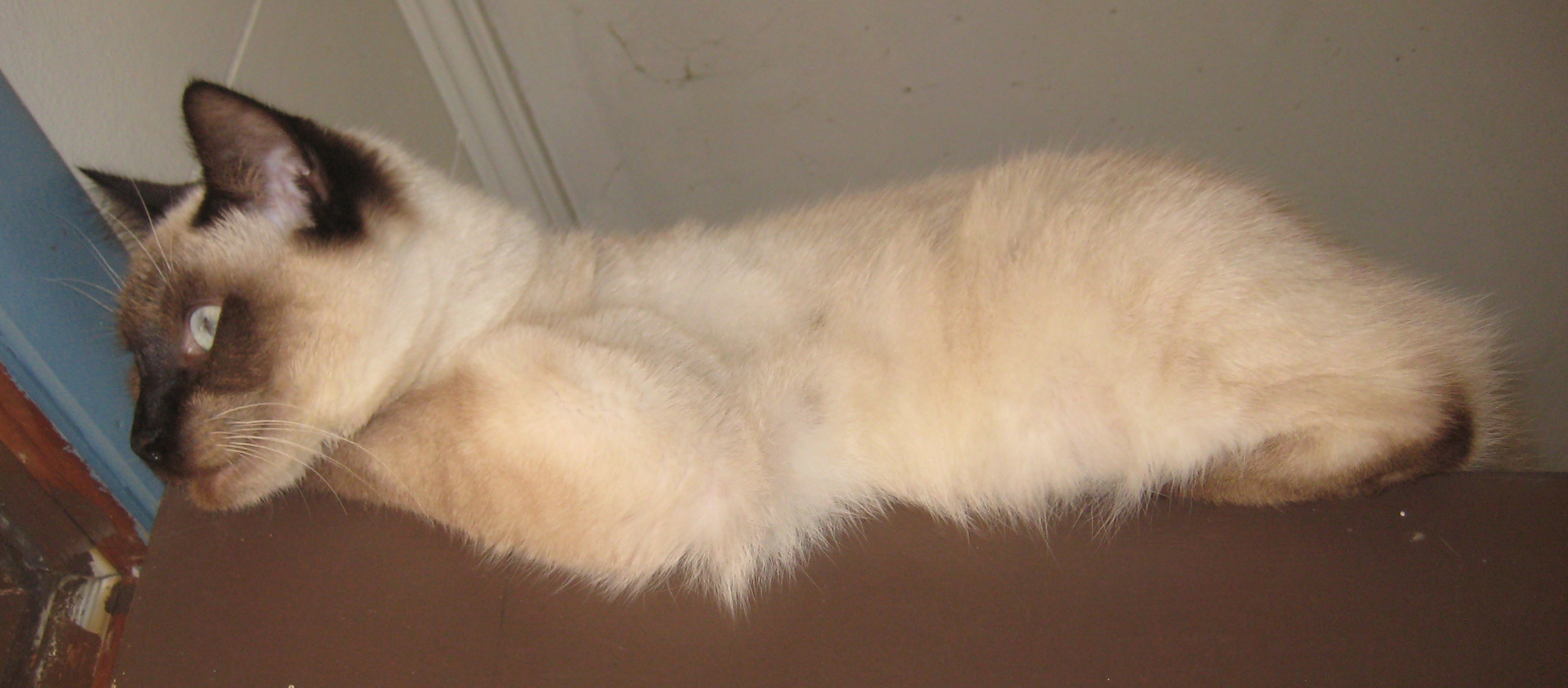
When I was growing up, we had a cat who would sit like this on the sash of an open window – 7 floors up!
 Virtual Brush Box