At the level I rode, hunter divisions had three classes: two jump, one flat. Entering two divisions was standard operating procedure. Therefore, six saddle seat classes should be inside the realm of possibility, right? I mean, I’m just trotting around in circles, not even jumping.
Ha!
I was blitheringly tired. Not so much physically as mentally. In terms of psychological effort, one saddle seat class has an impact closer to a full hunter division than to a single hunter class, let’s say one ASB = 2/3 hunter div. After six short Academy classes, I felt as if I had ridden four hunter divisions in one day. In one morning.
Pardon the white patch on the photo. My camera either needs to be cleaned or replaced. However, I wasn’t about to let this image get lost, white spot or no.
Alvin Ailey
71 Academy Showmanship Driving, 3 of 3.
72 Academy Reinsmanship Driving, 1 of 3
73 Academy Driving Championship, 3 of 3.
Thank you to the Wamble family for the chance to drive their wonderful horse.
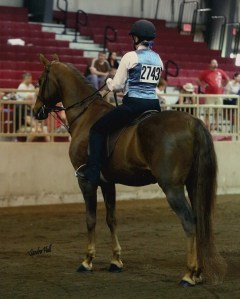
Sultan’s Miracle Man
75 Academy Equitation Adult WTC. 1 of 4
79 Academy Showmanship Adult WTC, 1 of 4
83 Academy WTC Championship, 3 of 11
Thank you to Courtney Huguley for the chance to ride her wonderful horse.
PLAY-BY-PLAY Driving
First class: Remembered to keep hold of the horse. Remembered that Alvin is more enthusiastic about showing than Natalie. Managed two different speeds of trot, as required. Generally pleased with my drive, even if the judge wasn’t.
Second class: Got complacent and forgot to stay with the horse. Alvin cantered. More than once. Oh well, there goes that. Line up. Pattern? Surprise! My first pattern in a cart. Ever. Watched the other two go. Drove as if I was riding the line. Alvin, being a rockstar, went where I asked. We nailed it.
Third class: The victory pass jazzed us up, so I made an effort to slow everything down. Too much. When I asked for the extended trot, Alvin said, ‘No thanks, I’m happy with this pleasure trot we got going on.’
It’s all Alvin. I’m just glad I was able to find the gears.
Riding
Sam and I continue to work on our partnership. We’ve gotten to the point – mostly – of being able to do it right. Now, we are practicing until we can’t do it wrong. At least, I am practicing. Sam just goes along being Sam.
LESSONS FROM THE SHOW Intensity
Performance horses show in two classes per show. For example, one class on Thursday night, the Championship class Saturday night. That’s it. Really? Surely they could handle at least one class a day? No, they can’t. And don’t call me Shirley.
My first inkling of the effort involved was watching the big classes at Louisville. During line-up, the horses were puffing and sweating like racehorses after a sprint.
In Academy, I have been learning to ignore the horse. This is why one rides schoolhorses, one can perseverate on one’s position and let the horse take care of him/herself. In real equitation, the rider has to insist that the horse also perform suitably. With a blue in my pocket, I experimented with this idea for my middle class. (I wasn’t going to mess with the Championship.)
I asked Sam to lift his shoulders and assume a Saddlebred frame. Being a stellar schoolmaster, Sam did. We would trot with verve and style for 1 or 2 strides. Then, my concentration would lapse. Sam would ooze out of frame. Ask again. Stride. Lapse. Ooze. And so on. I can see why a few minutes of this wears out both horse and rider.
The Diamond is a Tool
One of the Stepping Stone Farm ringside spotters pointed out that I treat my diamonds as a pattern instead of as a function of ring awareness. She’s right. In performing a diamond, horse and rider trot to a point at the end of the ring, instead of following along the curve of the rail [Boot Camp Begins]. The goal is to show that one is boldly directing one’s horse, rather than being swept along by the tide. This I do. I shall now perform the diamond. Behold, I am diamonding.
However, the second goal is to use the diamond as a way to take a path away from the other horses. This means being aware of the location of the other competitors and adjusting your position to maximum advantage. This I don’t. Until recently, I was far more used to being alone on the field of play. There is no way to practice for traffic management. It’s all game time decisions.
Prepare for Transitions
Saddlebreds perform their classes in the same order every time. Therefore, they know what comes next. Anticipating the canter is a common problem. Most of the time, 5 out of 6, I was able to ease Sam from the trot back to a nice flat-footed walk. Unfortunately, this resulted in a flat canter. I knew we could do better, but wasn’t able to manage it.
In the second direction of the last class, Sam hopped and fussed during the walk section. When I asked for the canter, he popped into the sweetest tea cup canter. Our canter pass was probable our single best pass of the whole show. It probably consolidated our third place in the championship.
In the future, get the flat walk, wait for the announcer, PAUSE, get a few beats of jazzy paws at the walk, then ask for the canter.
(Nope. Totally had the wrong end of the stick. Don’t drop, then pick back up. Coach Courtney says, “The horse should be ready to canter the entire time.” Report: Heathermoor. KTW 7/29/15)
What do you mean WE won? I didn’t see you out there trotting around. Sandra Hall Photography. Used with permission.
Wake UP!
I overslept. At a horse show. I know, I’m shocked as well. Since I had everything laid out, I was able to dive into my clothes and screech out the door. I was in the car 10 minutes after waking up. Since I had planned to arrive early at the show, I still had plenty of time. The shot of adrenaline I could have done without.
In the future, phone alarm AND hotel wake-up call.
This should be the show report, but I am still beat from the weekend. Fortunately, Sandra Hall Photography came through with web images from the photos I purchased. Report tomorrow. Probably.
Not last! Finally! With Alvin Ailey. Sandra Hall Photography. Used with permission.Sultan’s Miracle Man, the awesome Sam. Sandra Hall Photography. Used with permission.
Why yes, I have a blog. Let me give you one of these:
A homemade stopgap until I get my a. in g. to have postcards printed. They are an improvement on my last attempt [Marketing 101]. At least this time, the recipient knows it’s a blog.