Result: Hopping, fussing, and bouncing sideways at the strike-off. Noticeable but less than previously [Weekend]. Afterwards, we were able to keep going and develop a decent jog for a respectable distance.
Theory A: This is progress. While not calm, he is definitely calmER. The performance was better. By definition, a better performance is progress.
Theory B: This is not progress. We are no closer to understanding why he objects so strongly to such a simple question. If we are not addressing the central issue, we are simply arranging deckchairs on the Titanic.
Our house is divided. How do you vote?
______________
I have written a new Off Topic post, Why I Drove a Beat-up Jeep to My Senior Prom, over here. Telling tales on my father. This is where I get it from.
Day 3, continued Adult WT Equitation National Finals – 2nd
When we discussed my previous class, I tried to accrue what credit I could, “At least I diamonded.” Well yes, but apparently I leaned forward while doing so. Note to self, do not pitch forward into turns. Stay back. Not behind the motion but not flopping over the neck either. I did this thing.
A young horse is a more difficult equitation mount than a veteran. Sam or Alvin or Willie are so steady that I can leave them to their jobs while I flounce about on top. Trump, being young, is less consistent in his motion. As a result, I tend to luff like a badly-managed sail. When I asked what to do when I threatened to lose my balance, I was told to dig my knees into the saddle. When done right, the result is not stiffness. Knees-in becomes a short-hand for getting the butt properly balanced and using the upper leg. As I warmed-up for the second class, I realized that I had indeed been riding correctly. There was a small muscle in my right, inner thigh that was most displeased with this fact. A difficult area of the body to massage while in a warm-up arena. I told the muscle to get over itself and dug in. I would be quite lame by the end of the day.
As before, I rode with as much brio as I could muster and diamonded furiously. I recall locking onto one of the signs on the wall at the top of the ring and aiming for it as if I was a heat-seeking missile. Plus, I sat up and pushed Trump around the turns. I was quite chuffed about my ride.
I did make mistakes. I got caught behind the same slow horse twice. My bad. I should have seen the problem ahead of time and made a better job of going around. As it was, the speed differential was too great for me to pull back and go around. Nor did I quite have room to pass her on the rail. We sort of waddled along behind and to the outside while I tried to keep Trump from breaking down to a walk. We did miss her on the third go.
There is a proper procedure for trotting to the line-up [Ringmanship]. I am supposed to keep in the direction I am going, circle around, and pull in as close to the ringmaster as possible. It quickly becomes a poly-variable equation calculating my speed and position and the location of the ringmaster, to be solved for the intersection of the above while avoiding the center ring island and giving the judge a final look at my elegant self. I get it right about 50% of the time. Other times. I wander around the arena, thinking ‘Oh shit, how do I get over there?’ or, as in this class, ‘Holy cow, what piece of thin air did that oncoming horse and rider just appear out of?’
When my instructor came in to be my header in the lineup, I was expecting smiles and balloons. I did not get them. She was not optimistic. I had spent too much time covered up and hadn’t been seen. At least I sat up? Yes, but I was still waving my body parts about like an overly-exuberant orchestra conductor. Sadness.
We have not had time to debrief the show, but I gather that my instructor was surprised by the result. I dunno why. I simply took what she told me to do and sold it. OTOH, this is not the first time I have startled a riding teacher by pulling a rabbit out of a show hat. I had a plan. I executed the plan. It could have gone either way, but it went my way. Result, I look like a hero. Never underestimate the ability of an Ivy League liberal arts major to assess a situation and then layer on the bullshit.
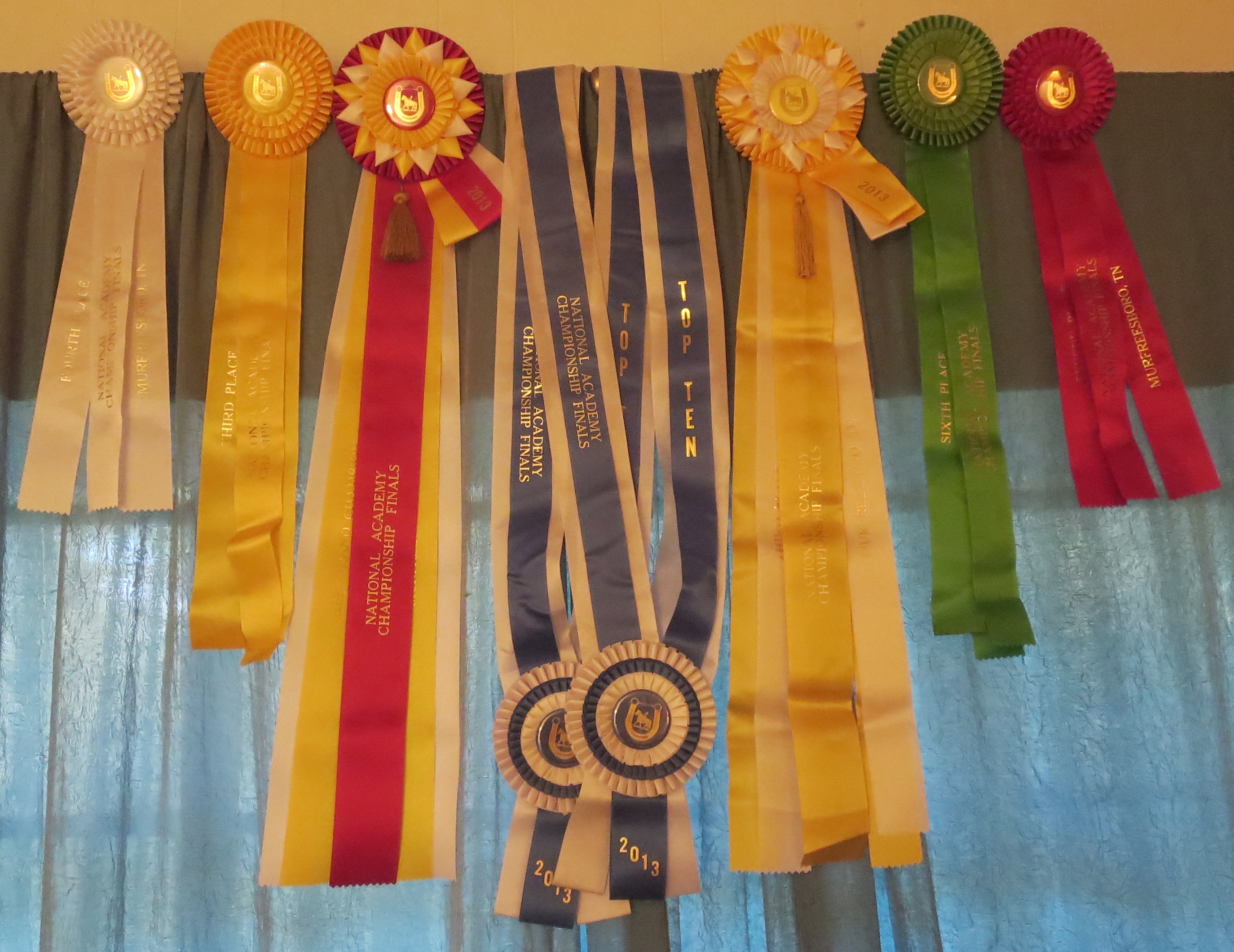
I have now shown Trump at two big shows [Report]. Both times, we have been awarded a neck ribbon and the opportunity to ride a victory pass. What a horse.
I did not win a class.
I think I’ll survive.
My Photos
Not many from the show. None with my camera. A few with the cell phone for Tweets, see sidebar or recap in Saturday’s upcoming post. The Tweet project [Toy] was partly responsible for the lack of camera photos, but mainly I was in princess mode entire time.
At most shows, I ride in one session – usually Saturday afternoon – and then mooch about trying to be helpful for whatever of the show I can stay to watch – usually Friday and Saturday evenings. These are the times I take pictures. Once the make-up goes on and the hair-spray is applied, I’m thinking about my ride, not photos. So, all sessions, no photos. Plus, it’s hard to handle a camera when one’s gloves are taped to one’s wrists. Seriously. It smooths out the line and prevents gaps.
Photos by Sandra Hall
National Academy Championship Horse Show. Chestnut horse, light blue vest, only helmet.
Friday Morning > 014 – WT Pleasure Adult
Friday Evening > 021 – WT Equit Adult
Saturday Morning > 039 – WT Equit Adult Champ
Saturday Evening > 053 – WT Pleasure Adult Champ (last class of the flippin’ day …
Sunday Morning > 054 – Adult WT Pleasure NF (… and the first class the next morning!)
& 062 – Adult WT Equit NF. I ordered NAF13-062-029. I usually wait for advice on which one looks best for horse & rider. This time, I wanted the victory pass, complete with ribbon blowing in the breeze. In the pic, Trump is pulling a trifle. My instructor is at the end of the ring tossing dirt to attract his ears. Trump is making a beeline for her. I am letting him rock & roll. I seem to have trouble keeping the lid on during victory passes. The following shot, NAF13-062-030, is a close up of me. It is not as good of the horse, so I did not order it. However, take a look if you want to see what it feels like to achieve a year-long goal.
POB – Parade Of Barns:
Stepping Stone Farm, NAF13-POB-023 – NAF13-POB-027, including greeting my adoring public, NAF13-POB-026. Still shot NAF13-POB-097.
Trump & his owner are in four classes of WTC 13 and 14, B section, Friday & Saturday mornings. Light tan pants, pink vest, dark pink (?) tie.
And that, Ladies and Gentlemen, was my show weekend in Murfreesboro, TN. Next time, we canter. On purpose.
Day 2 – Moving On Adult WT Equitation Championship – 3rd
In a saddleseat walk-trot class, one enters at a trot, walks briefly, reverses, trots in the other direction and then trots into the line-up. There might be a short walk after the reverse and/or between the second direction and the line-up, or there might not be. Essentially, the exercise is trot this way, trot that way, boom, done. Achieving the correct diagonal looms large when all you’ve got is two trots. The ABS are so smooth, I find it easy to sit the first few steps, get the feel, and then pick up the correct diagonal. I can usually sneak a swift glance down my nose to confirm this. When I’m thinking.
After the reverse, I went charging off into the trot and began posting immediately. Unsure of my diagonal, I switched, then switched back. Feeling the correct diagonal on the fly requires rhythm. I got the rhythm of a spider in oversized flip-flops. So I need to look and count. This leaves me staring down at the horse’s shoulder as if the secret of the universe is written on the withers. In the background, my instructor is screaming for me to change, but I’m flinging out so many different diagonals, I’m not sure if she wants me to change from were I was or from where I am now. Plus, Trump may have been racking. Sometimes he does that if the rider doesn’t get the trot started properly.
I was pleased to take third.
Although I still had no idea what I was doing right or wrong, I was much happier to be ignorant in yellow. A few of the kids were commenting on the ribbon colors, saying they liked the hue if not the import of the lower-placing ribbons. Nope. Give me the primary colors any day. I’m not sure if I prefer blue, red, and yellow qua colors or that I have been showing for so long I have internalized the norms.
WT Pleasure Championship – 6th
Since I was qualified for Sunday, barring disaster, we switched horses to see if a new horse/rider combination might excite the judges. The judges where not particularly excited, but the horse was. Willie [Show Photos] has been known to be picky about the canter. Unless you ask just right, he may decline. Not so much today. Every time the crowd whooped and hollered, Willie would canter off. Saddleseat crowds whoop and holler. A lot. We cantered. A lot. In a walk-trot class, need I remind you. Afterward, someone said, in tones of great portent, “You cantered in front of one of the judges.” My response: “Honey, I cantered 5 or 6 times. I cantered in front of everyone.”
The class was the most flat-out fun I had all weekend. Since my placing didn’t effect moving up, there was no pressure going in. After the first or second canter, there was even less pressure. I just gave up and went with it. Throughout the weekend, other horses were excused from the ring for bad behavior. I guess we didn’t look out of control, at least not overly so. I didn’t feel a danger to myself and others. I just had trouble keeping my horse in the correct gear.
Willie wasn’t spooking or running off, per se. He was simply ON. He was actually throwing down an athletic, active, forward canter. At the time, I was too busy trying to arrange my knitting. In retrospect, if I could have driven him like the fine sports car he is instead of stomping on the accelerator and jamming the brakes, we would have looked sweet. Probably not equation style, but sweet none the less.
We came in sixth. The mystery is not that we came in sixth, but that we did not come in last. Someone asked what the other person did that was worse than my round. Dunno, I was too busy cantering to see.
Trump would be my ride for Sunday.
Motivational sign, B side
Day 3 – Reserve National Grand Champion
In the morning, my system finally revolted from four days of restaurant food, stress, and lack of sleep. Turns out it wasn’t the bigness of the show as much as the longness. I didn’t have any OMG-the-Eventing-gods-are-in-my-division moments. I wasn’t blow away by this horse or that rider. It was simply a string of long days aggravated by restless nights. I felt like crap. However, I nibbled a few raisins and told myself that I want to do this more than I want to not to do it.
Adult WT Equitation National Finals – 3rd
Since the best I had done was in the first class, tried to ride the same way. I diamonded the everliving stew out of the ring. I don’t think I went along the rail or followed the curve even once. I was on full-tilt boogie. When the call to walk came, I was at the top of the arena. I could have easily walked right then. Nope. I decided I was gonna act as if I had started the straightaway and therefore needed to ‘finish my pass’. The entire class is walking and I’m trotting? Bring it on. I think I am getting the hang of this, ‘Hey judge, look at me.’ paradigm.
When we lined up, each entry was allowed to have one handler to help with the Top Ten neck ribbons. Since my class only had seven entries, we all got one. I got surprisingly choked up as I watched the ribbon go around Trump’s neck. Granted all I had to do was pay my entry, show up, and not fall off. I was still thrilled. I’m a little verklempt just writing about it.
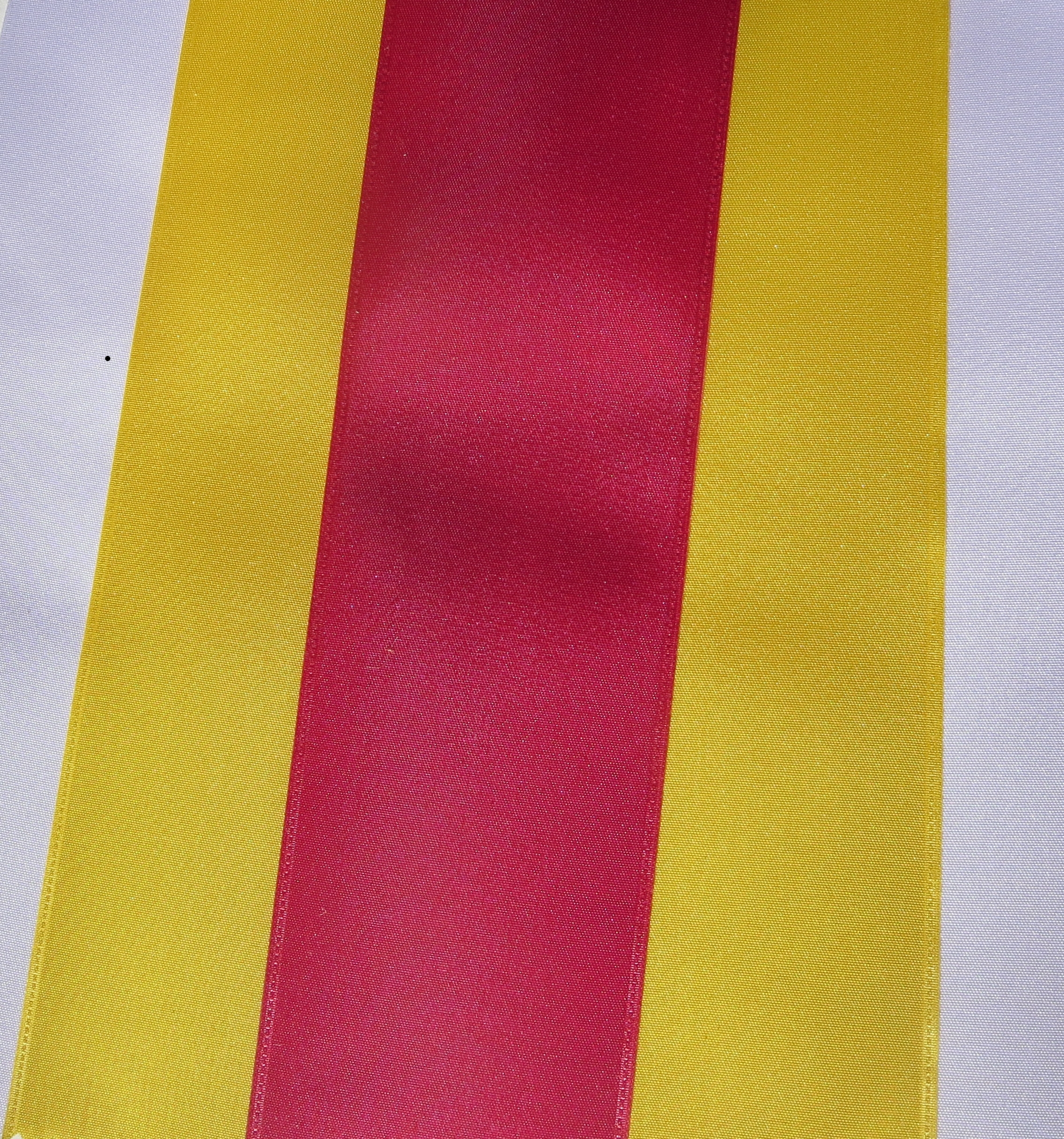
Then they announced the ribbons, starting with third. I wasn’t sure why they were starting in the middle, but was happy to pick up a big fluffy pile of yellow acetate. Afterwards, it was pointed out to me that they only awarded three places. Seriously? Hot damn.
There was some mild joy in Mudville over a Top Three. I was told that if I tighten up, I could do even better.
Day 0 – Lead-up & Warm-up
I was a mess. Anyone who interacted with me in the run-up to the show can attest to this. I managed the standard activities of daily living. However, if the slightest thing went wrong, I was immediately reduced to a quivering heap. The nerves pretty much started Sunday before the show and ran through to the following Sunday.
I left after lunch on Wednesday. The show started on Friday. On Thursday, the day before the show, the plan was to get all six horses into the ring and then to give baths. With three riders, we each rode twice.
I started with Trump. Bravery is not the lack of fear. Bravery is having your eyes on stalks and still working as requested. We where all thrilled with the baby horse for pulling his socks up acting like a grownup. The inner border of the arena had signs all around advertising the show. Trump spooked to a greater or lesser extent each time we went by one. I kept him trotting until he decided this was more work than it was worth. He never completely got over it but he did straighten up and wonder how he got on the trotting train. ASBs work hard, but they don’t work long.
For the second shift, I rode Alvin. Trump is immensely fun to ride, but I’m always on edge until I get on and we get moving. Not so with Alvin. As I tacked up, I was able to relax. This will be great, I says, I’m riding the old veteran. Which apparently Alvin heard. Old veteran?! I’ll give you old veteran. He then went out and behaved worse than the youngster. He spooked this way and that in the warm-up ring. He flew around in the arena. In the first direction, I was able to get a jump on the canter and organize the excess energy. In the second direction, Alvin said FTS and simply ran off. This is his third? fourth? time at this show.
To preserve the hoof, saddlebreds don’t get full baths often. Therefore, they were unpleased to be getting baths on this day. They were doubleunplus unpleased to be getting them with cold water. I pled ignorance. At home, I use a ton of water. Our two get hosed off so much in the summer that our water bill goes up. However, it’s probably been decades since I’ve given a full-on, soapy bath to a horse. Back when I was showing, I had a mostly-plain bay showing in jumpers. Low detergent requirement. So, I ended up holding rather than bathing. Still, it is hard to remain dry when horses and hoses are going every which way.
When I drove up, I had been surprised at how few horses there were. At most shows, riders have one or more horses. At this one, each horse had one or more riders. Therefore, what felt like a big show had what felt like far too few horses.
My motivational sign for the dressing room.
Day 1 – Just Another Horse Show
Back in 1998, I did an article on the first Rolex**** [“Ladies and Gentlemen, Please Sit Still …” Horse Show July/Aug ’98]. Most folks oohed and aahed about how special it was to be hosting the first regularly scheduled four-star in North America. I agreed. Multiple-Olympic rider Bruce Davidson did not. He said it wasn’t special. That was the point. The reason for standards is so that each show performs as expected in terms of facilities, footing, courses, etc.
I think I understand what he means.
I was, as you might have noticed, looking forward to this show. I knew I would be okay once I got in the ring but was a basketcase while waiting. At some point on the first day, I realized that nothing was different. Here was a warm-up area. There was a ring. I knew what to do in A to get to B. You do what you always do. You prepare as you always prepare. You go in the ring and ride as you always ride. Whatever pageantry surrounds the arena, whoever is watching your ride, doesn’t change what you do. The bigger the stage, the less exciting your routine should be. Experiment with new tack, new techniques, and green horses at local, schooling shows. Part of being ready for a big show is to know your part as thoroughly as possible.
Ride the big ones like the little ones. Ride the little ones like the big ones. I was told this is reference to jumps. It holds true for horse shows as well.
When the class counts came out, I learned that the Adult Walk-Trot division had seven entries. Ten would go through to the final. Rational thinking would suggest that I could have relaxed at that point. I wasn’t going to be involved in the cut-offs and qualifiers that the rest of the Stepping Stone riders had to undergo. I assumed nothing. Partly out of superstition but mostly because this was riding. As soon as you assume, some horse will take it upon himself to prove you wrong, see warm-up sessions above.
On the down side, I had a class in every session. The WTC adults and kids had two classes in the morning session. The WT kids had two classes in the evening session. My division of WT adults was the only one that went morning and evening. I posited that a split class was required for scheduling reasons and they felt that the adults could handle the extra stress. In return, it was suggested that perhaps TPTB felt the adults didn’t have the stamina for two classes in a row. Since the idea of three straight days of stress might do me in, I tried, with moderate success, to look at it as the chance to ride in five horse shows. (Sunday was one session.)
Adult WT Pleasure – 2nd
My only clear memory of the first class is trotting down the chute and hearing my instructor say, “Bust up in there.” We stormed into the ring. I know that I diamonded the hell out of the class but I don’t really remember doing it. I know that the class felt long enough for everyone to get a good look by the judges but not so long that we were flagging.
Afterward I gave my instructor an enormous hug of gratitude. Whatever else happened that weekend, I had ridden in a National Academy show.
Adult WT Equitation – 4th
My directives for the next class where to tighten up and sit still. No surprise there. So I did. Or at least I thought I did. I was not happy with fourth. It wasn’t just sinking in the placings, which is never fun. It was that I had no idea why I sank. My progress throughout the year seemed erratic. Some classes I would ride my ass off and win. Other classes, I would ride what I thought was exactly the same way and get a pat on the head. It wasn’t the losing – okay it was partly the losing – it was the not knowing.
While the plan was to improve as the weekend went along, it would be hard to go from middle of the pack to toppling the woman who had won both my classes. My best hope was to reclaim the second spot I got in my initial class. I was playing for Reserve.
As with Hunter Equitation, Academy Equitation has its own highly mannered style. I wasn’t intimidated by what I saw, but I had to admit that they were doing something I couldn’t. It was a distilled version of the things that had been troubling me all year: bring everything up, be still, be quiet.
Since I had the joy and delight of double sessions, I had double sessions of hair and make-up as well. First thing in the morning for my first class. Touch-ups in the evening for my second. I brought along the special shampoo that I use to get gunk out of my hair after swimming or going on fire calls. Even with that, plowing through two layers of hairspray that night still felt like driving a pitchfork through a pile of straw.




 Virtual Brush Box