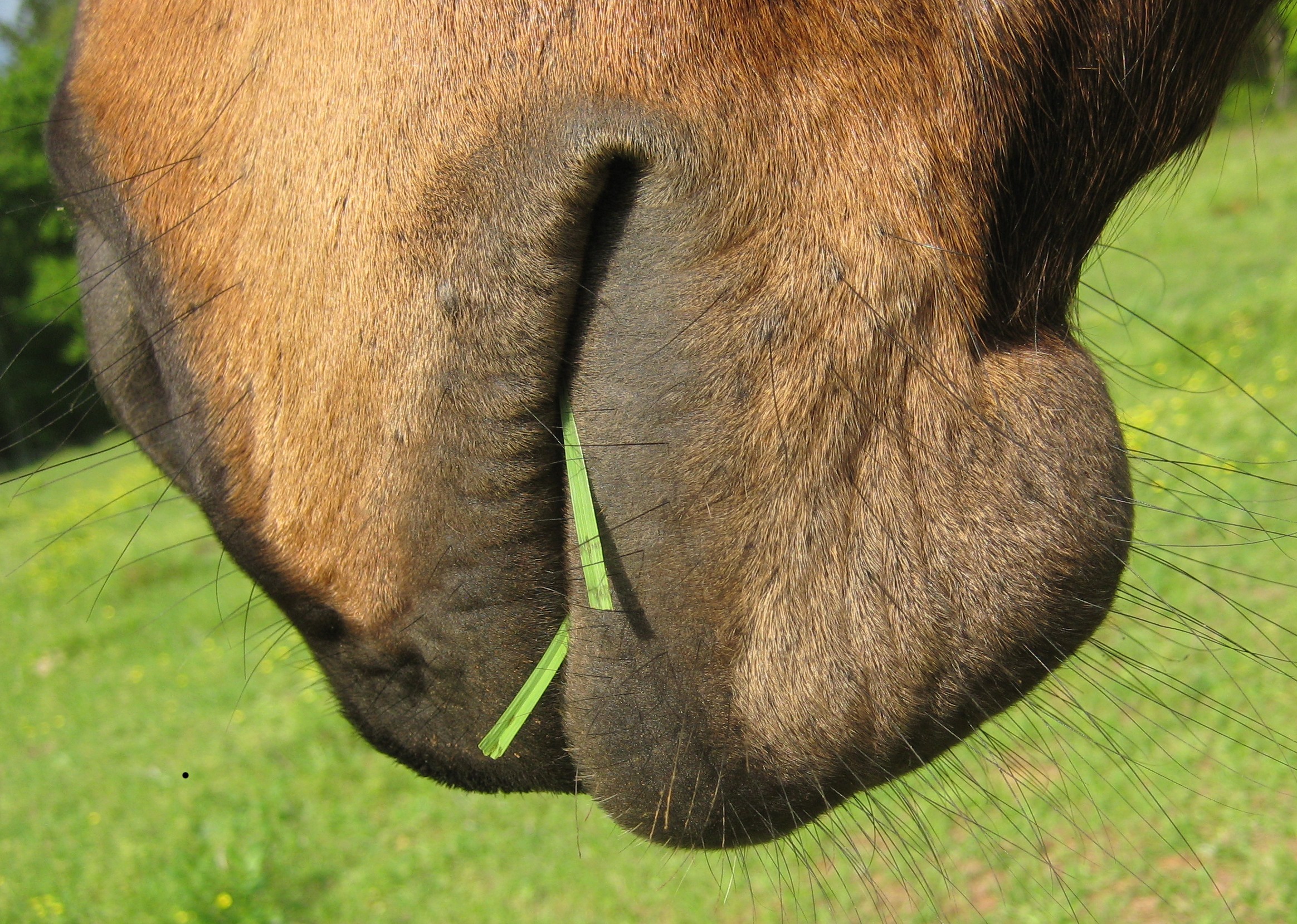
Hand-grazing a horse is almost hypnotic. We stare blankly at the moving parts and listen to the sound of grass destruction. We look, but how much do we see? Having done this a lot lately, we have come to a few conclusions. Others more than I.
1) Constancy.
Horse shovel the next bite in the front as the previous bite is ground up in the back. If I tried this, I’d be wearing my salad. Alas, I had to have this pointed out to me by a non-horse friend in college. All those years of being around horses trumped by 20 minutes of scientific observation.
2) Selectivity.
Mathilda likes low to the ground or the top layer. Not so much the middle. Between the rain softening the ground & M tying up our time, the pasture growth has gotten away from us. She enjoys biting the heads off a grassy, stalky plant that has sprouted (seeded?). This was hubby’s observation. He’s the chef, so he’s used to keeping track of what foods get eaten.
3) Mobility.
They take a bite or two & move on, even if the new grass is of the same type as the old. They don’t settle down & strip an area they way we would an ear of corn. I don’t notice this as much as hubby. I simply stick my nose in a book & follow her about. I’ll look up & think, Hmm how’d we get all the way over here? Plus he grazes her first thing in the morning, when she tends to be on a mission.
4) Dexterity.
I will watch M tear at patch of grass but leave one undesirable flower/weed standing. How do they manage with those fat noses of theirs? I couldn’t accomplish that with opposable thumbs and reading glasses.
rogress is by definition measurable only in hindsight. Running a 7-minute mile is awesome if it represents a personal best. Less so if the runner previously lettered in track during college.
So, is it a bad sign that M got stuck over the weekend [Debriefing]? Or a good sign that she was able to get to her feet more easily than the previous incident? Is she more visibly tired because she has given up the fight? Or because her leg has stopped hurting as much and she is starting to relax?
Similarly, have the last few weeks been good for Rodney or not? He has not been asked for even the small exercises he had been doing [Bunny]. There are days when I can't muster the mental energy to give him a good grooming. While he is getting little direct attention, he is getting hordes of low-grade, indirect attention. We are in the barn all the time. He gets carrots when Mathilda does. He gets pats as we go by. We talk to him. We move him from the stall to the field & vice versa. Will this time be a set-back in our nonexistent schedule? Or turn out to be a inadvertent bonding session?
While he is learning to keep his shirt on, we are learning what to do to keep him from losing his shirt in the first place. One of the hard parts of Saturday morning [CAST!] was catching Rodney to get him out of the way. He was convince that all the yelling and crashing about on our part was aimed at him. I dug down for my zen-like patience [Lowercase] to approach him calmly while chattering nonsense words of reassurement. I succeeded and am pleased. But I did have to wonder, if 5 minutes of ZLP wears me out, how will I ever maintain a day’s worth to keep him together at a horse show?
Apologies for the cryptic post yesterday [CAST!]. On Saturday morning, Hubby was greeted by Mathilda flat out on her side. He’d heard her kicking at the stall, so he knew she was awake. She has rolled over and gotten herself stuck. In hindsight, it only took a few minutes and some maneuvering to get her back on her feet.
Deep Back Story
Many years ago, a horse at the barn at which I boarded got himself cast. He was rolled over on his back with his legs up against the wall. Every helpful, I jumped in and gave his hooves a yank. Whereupon he flopped onto his side & heaved to his feet. Easy-peasey. Except that as soon as felt the first breath of freedom, he flailed wildly with his hooves, clocking me in the head. Note to self, next time avoid the feet.
Back Story
A few weeks ago, Mathilda lay down to roll and had trouble getting up. Since seeing her stuck on the ground had been our fear since her injury, I descended immediately into screaming hysterics. I did everything to get her up immediately. Now. Right away. The sort of urgency you bring to preventing a colicking horse from rolling. I made it infinitely worse. She staggered 3/4 of the way up, collapsed, fell, and rolled. It was horrible. It was also fortuitous. She ended up pointed across the hill instead of up it & used the terrain to hop to her feet. Note to self, next time panic more slowly.
Back to Our Story
So on Saturday, Hubby comes down the path yelling my name in that tone of voice you do not want to hear. He said, “We have a problem*.” Which isn’t nearly so funny when you really do have a problem.
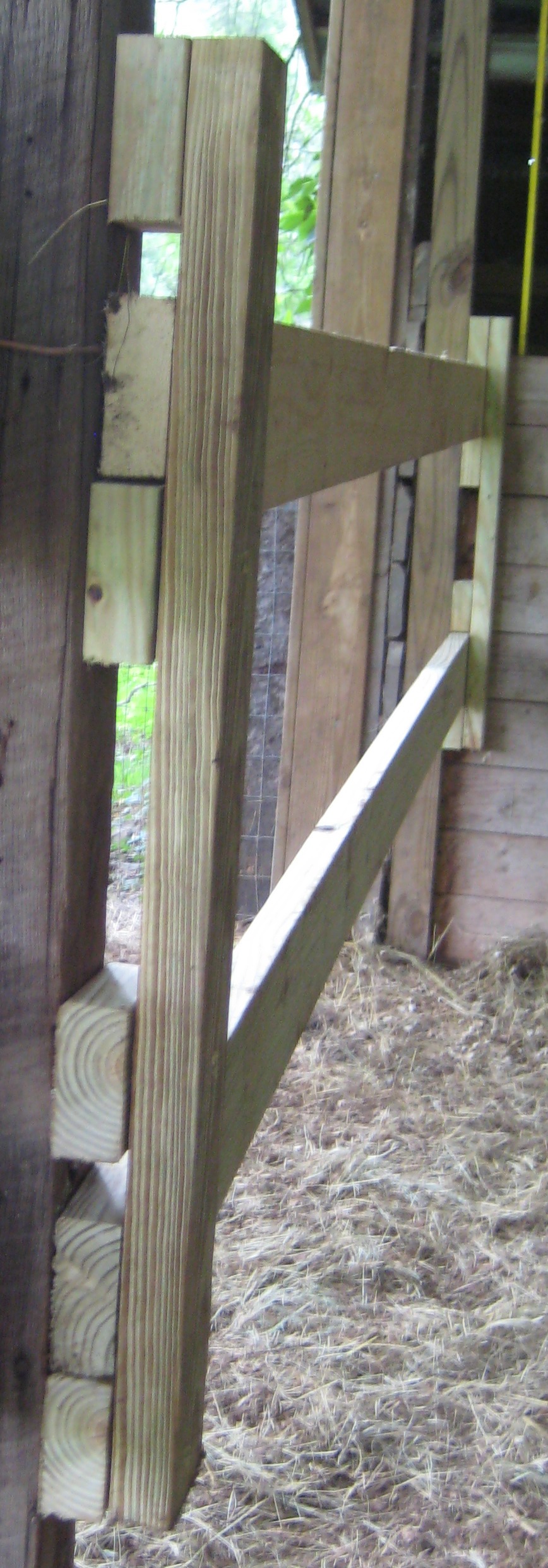
New barrier. He does good work.
Mathilda wasn’t classically cast. She was lying on her left side, with plenty of room for her legs. However, that is her weak side. So she couldn’t get up nor roll back over. We took a collective deep breath (see note 2), thought about the situation, and decided to roll her over, with Hubby using a rope (see note 1) around her hind legs with me pushing on her fronts. Unfortunately, this resulted in her wedged up against another wall. More not panicking. We tried banging down one of the walls. Understandably, the incredibly noise caused her to fuss and shift about. That’s out. The shifting brought her more into the center of the stall. The tow rope around her front end & a hefty heave by hubby got her aligned and able to roll up into meatloaf position. With the help of more time & a hay bale, she rose gracefully to her feet. End of acute crisis, beginning of decompression and renovation.
First order of business was where to put her. She is not cleared for the pasture & no way was she going back in the stall. If she had another problem, we wanted lots of room to maneuver. My handy, wonderful, hard-working, in-house carpenter spent the rest of the day building sturdy but movable barriers to block the two entrances to the run in-shed. Mathilda now has the space of fours stalls to move around in.
Although it was not the way I would have wished to arrive at the solution, turns out to be a darn good one. The pen area gives her room to move, thereby exercising her joints/muscles/mind without the risk of her tearing around the field on three legs refusing to be caught.
The crisis itself was quite short. The adrenaline poisoning took a day and 1/2 to wear off.
C.A.S.T. – Coalition to Abolish Slavery & Trafficking CAST 2012 – Science teachers gather in Corpus Christi TX in November to “Get Your Geek On”. C.A.S.T. – Couples Association of Sports Tournaments:
Coming together is a beginning.
Keeping together is progress.
Working together is success.
Henry Ford
or Cast. As in horse stuck in stall. As in longa$$ day. As in she’s fine; barn has a new holding pen; we’re beat.
The man in the photo is a historical reenactor from Colonial Williamsburg. His costume and tack are authentic down to his stirrups. Should he ruin the 18thC look by plonking a safety helmet on his head?
I want to say yes. I really, really, do. I stand on my record as a helmet evangelist [Helmet, Yet More, sidebar]. I know there is no such thing as a totally bombproof horse. Even the best-intentioned horse can slip. Plus, there is no totally safe situation. I’ve had a horse fall over with me at a standstill. (Attempting to spook on gravel, I think.)
Much can be done invisibly. For example. wooden carriage shafts are internally reinforced with metal to prevent bars shattering and gouging the horses. Plus, Colonial Williamsburg has the money and expertise to do make the modifications subtle. Most of their buildings are fitted with fire alarm and sprinkler systems. I toured the Governor’s Palace with a 24-year veteran of the fire service and she was only able to spot one alarm.Ye Olde Fire Hydrant
Colonial Williamsburg already makes visible concessions to safety, see photo. Plus, this would be an opportunity to send a message on the importance of safety over looks.
Better photographers all over the Internet have taken scenic shots of the Colonial Williamsburg horses in action. My tour is of the things only horse folks could care about:
Yes, horses actually use this.The barn is cool, airy …… and safe.So tidy!With this as a wash area …… I might keep my leather this clean.Author making friends with Cavalier, a 5yo American Cream Draft. Photo by Karen Smith.
Thank you to the Colonial Williamsburg Coach & Livestock staff for entertaining a horde of thirsty journalists & to Alltech and the American Quarter Horse Foundation for sponsoring the reception and shuttle [Why].
Mathilda (horse) has taken an aversion to Lady (dog). Before, she had left the dog hassling to Previous Horse, who had a zero-tolerance dog policy. Now, Mathilda has taken up PH’s mission of keeping the field clear of dogs. Therefore, while Mathilda has been unsteady in her back end, Lady has been confined to her 1/2-acre dog purgatory in the front yard. She is not pleased. Vocally. This morning, Lady proved that she has been improving her door-opening skills & joined us for the pre-breakfast graze.
Lady bounced about, happy to be free. Mathilda vacuumed up the grass. I juggled leadrope and tea mug. Suddenly, Mathilda pinned her ears and went after the dog in a lunging, hopping maneuver that involved a moment with all four of her feet off the ground. I yelled. Horse and dog froze. It was hard to tell which of the three of us was more startled.
Years ago, Hubby & I were driving around Hunstville, AL, in our old VW Jetta. Suddenly, a set of railroad tracks came out of nowhere. We were going a wee bit faster than the engineers had in mind when planning the road crown. Inspired by being in Rocket City, Hubby launched the car over the tracks. All four wheels off the ground. We were airborne long enough for me to think, ‘Okay, this is weird!’ This morning was like that. Both car and mare were/are big, heavy, black things that you don’t expect to see off the ground.
If I could trust her, I would be thrilled to take this as a sign of improved health. Unfortunately, recent history [Life Lessons] has show that Mathilda is listening to the hormones & pain-killers swirling through her brain, rather than the cautionary messages coming from her back legs.
What was the most recent (pleasantly) surprising thing your horse has done?
 Hand-grazing a horse is almost hypnotic. We stare blankly at the moving parts and listen to the sound of grass destruction. We look, but how much do we see? Having done this a lot lately, we have come to a few conclusions. Others more than I.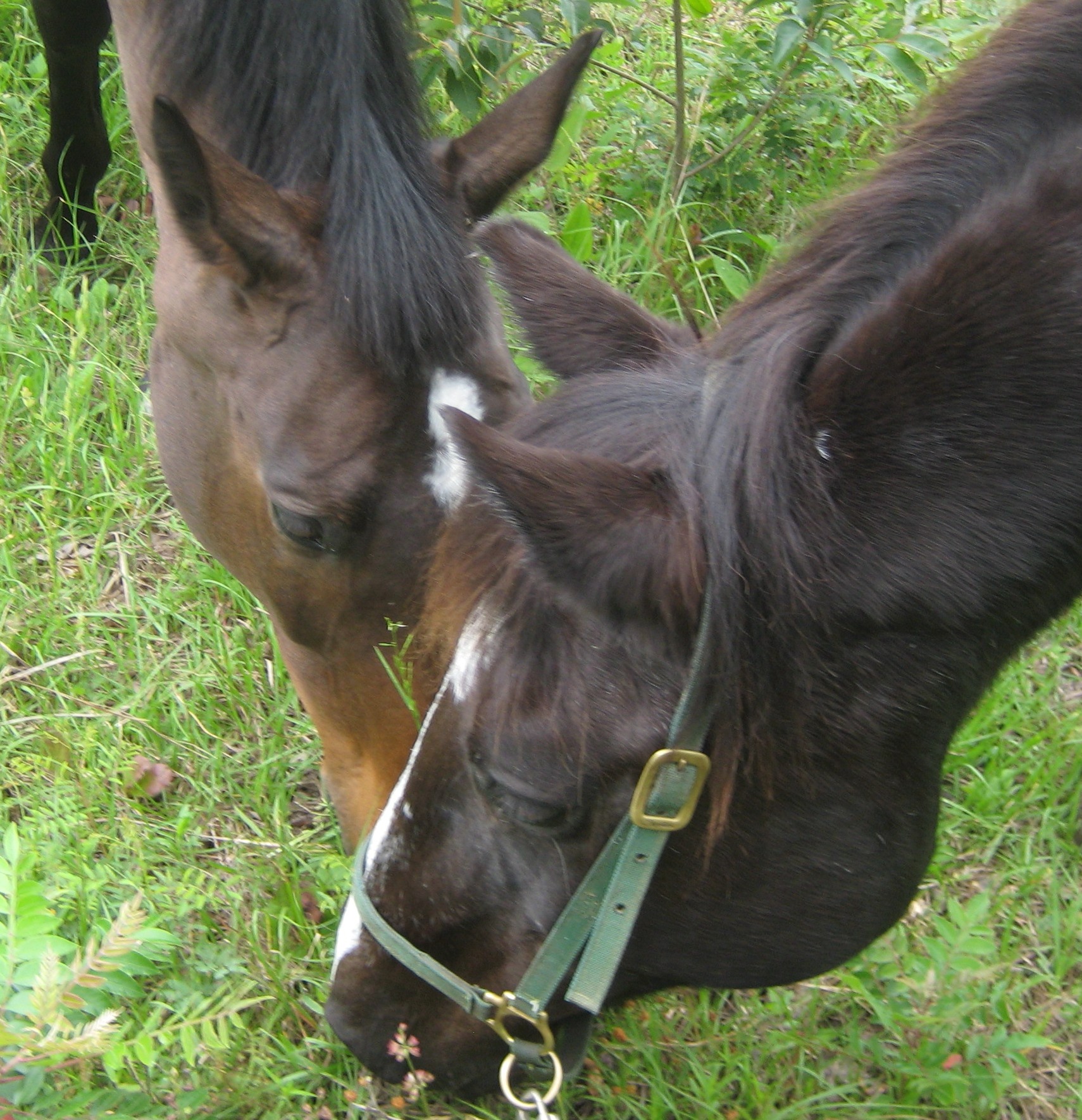



 Virtual Brush Box